

Key Takeaways
- A collective investment scheme can involve pooled investor money, property managed as a whole, or both under Section 235 FSMA. Investors in a CIS generally do not have day-to-day control over management of the underlying property. A scheme does not avoid CIS rules simply because it is marketed as property ownership, a fixed-return investment, or another type of opportunity. FCA v Forster showed that courts can look at the substance and economic reality of an investment arrangement rather than relying only on its label. An authorised collective investment scheme and an unregulated collective investment scheme are not the same thing. UCIS investments can carry additional risks and restrictions on how they may be promoted to retail investors. Investors should check the FCA Financial Services Register before relying on claims that a firm or investment is regulated. A collective investment scheme is a legal and regulatory classification, not a guarantee that an investment is safe or profitable. Fees, liquidity, underlying assets, operator risk and regulatory status should all be checked before investing. UK rules were updated in 2025 to exclude certain qualifying cryptoasset staking arrangements from the CIS definition.
A collective investment scheme, usually shortened to CIS, is a legal category used in UK financial services law for certain investment arrangements where people participate in profits or income from property without controlling that property on a day-to-day basis.
That sounds close to the everyday idea of a pooled fund, but the UK definition is broader than that.
A CIS can involve money, securities, property or other assets. Investors may contribute to one pool, but pooling is not the only route into the definition. An arrangement can also qualify where the property is managed as a whole by or on behalf of the operator.
That distinction matters because an investment does not have to call itself a fund to fall within the CIS rules.
The starting point is Section 235 of the Financial Services and Markets Act 2000, usually referred to as FSMA. The FCA’s own perimeter guidance follows the same framework.
For investors, there is a practical reason to understand this. Some investment opportunities are sold as property deals, business arrangements or income products. The legal position depends on how the arrangement actually works, not just the name on the sales page.
The High Court’s decision in FCA v Forster & Ors [2023] EWHC 1973 (Ch) is a good example. Investors were sold leasehold interests in individual care-home rooms and promised annual returns. The court still found that the arrangements amounted to an unauthorised collective investment scheme.
If you are still learning the basics of investing, it may help to first read our guide on what to invest in for the long term as a beginner. This article goes one step further and focuses on the legal structure behind certain pooled or professionally managed investments.
What is a collective investment scheme in simple terms?
In plain English, a collective investment scheme is an arrangement where investors take part in the financial results of property or assets that they do not manage day to day.
The legal definition is more precise.
Section 235 FSMA says a CIS involves arrangements concerning property of any description, including money. The purpose or effect of the arrangement must be to allow participants to receive profits or income arising from the acquisition, holding, management or disposal of that property, or from sums paid out of those profits or income.
The participants must not have day-to-day control over management of the property.
The arrangement must also involve one or both of the following:
- Participants’ contributions and the profits or income from which they are paid are pooled.
- The property is managed as a whole by or on behalf of the operator.
This is one of the most important details in the definition.
A CIS does not always require investors’ money to be sitting in one obvious common pot. An arrangement can also fall within the definition because the property is managed collectively.
The FCA explains the same test in its PERG 9.4 guidance on collective investment schemes.
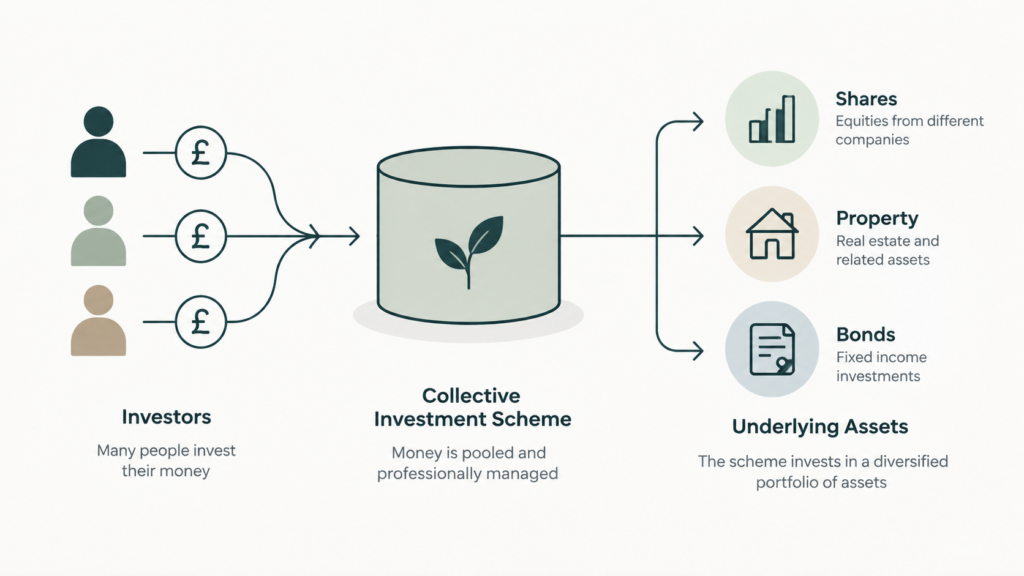
The four questions behind the UK CIS test
The easiest way to understand Section 235 is to break it into four questions.
1. Is there an arrangement involving property?
The word “property” is deliberately broad.
It can include money, shares, bonds, real estate and other assets. This is why CIS questions are not limited to traditional mutual funds or unit trusts.
A property scheme can potentially fall within the rules. So can another type of investment arrangement if it has the necessary features.
HMRC also describes collective investment schemes as arrangements that can allow investors to pool assets into a professionally managed portfolio. Its guidance notes that authorised investment funds can hold gilts, bonds, quoted equities, unquoted investments or property.
2. Are investors participating in profits or income?
The arrangement must allow participants to receive profits or income connected with the underlying property.
That income might come from investment growth, rent, interest, operating revenue or another source.
What matters is not simply the wording used in the brochure. The real source of the investor’s return matters too.
3. Do the investors have day-to-day control?
This is an important dividing line.
An investor can have legal rights without having day-to-day control.
For example, a person might receive reports, vote on certain matters or own an interest in an asset. That does not necessarily mean they are the person making daily management decisions.
If an operator is making those decisions on the investor’s behalf, the arrangement starts to look more like the type of structure Section 235 is concerned with.
4. Is there pooling, management as a whole, or both?
This is where many simplified explanations become too narrow.
Pooling is one route.
Management of the property as a whole is another.
The FCA’s guidance makes clear that either route can satisfy this part of the test, or both can apply at the same time.
That means an arrangement does not automatically fall outside the CIS definition just because each investor is linked to a particular asset on paper.
Does a CIS always mean investors pool their money?
No.
This is probably the biggest misconception around the term.
Most people hear “collective investment scheme” and imagine several investors paying into one fund. That is a common structure, but it is not the full legal test.
Section 235 allows an arrangement to qualify where contributions and returns are pooled, where the property is managed as a whole, or where both conditions apply.
This became especially important in FCA v Forster.
What happened in FCA v Forster?
The case involved a care-home investment business associated with the Qualia group.
Between 2016 and 2020, Qualia Care Properties Ltd and Qualia Care Developments Ltd offered investors long leases over individual rooms in care homes. The rooms were then sub-let back into the operating structure.
Investors were promised returns of around 8% to 10% of the purchase price per year during the sublease period. The FCA said the leases generally cost between £50,000 and £75,000.
According to the FCA, the companies took around £57 million from 380 investors.
The High Court found that the arrangements amounted to an unauthorised collective investment scheme.
The FCA also said the promised returns were not realistically achievable and that false and misleading statements had been made about the sustainability of the model.
The decision matters because the investment had been presented in a form that could look like direct property ownership. Investors were buying leasehold interests in specific rooms.
But that did not settle the legal question.
The court looked at how the arrangement worked as a whole.
Why the court looked beyond the label
Burges Salmon’s analysis of the Forster judgment highlights an important point: the court considered not only the contracts and conveyancing documents but also the brochures and promotional materials used to sell the investment.
The substance of the arrangement mattered more than the label placed on it.
That is useful for any investor evaluating an unfamiliar product.
Imagine a promoter says:
You are buying a room, so this is simply a property investment.
That statement does not answer the regulatory question.
You would still want to know who controls the property, how returns are generated, whether the assets are operated together, whether cash flows are shared across the arrangement and what permissions the operator has.
The same principle applies outside property.
A product can be described as a business opportunity, income plan, private fund or alternative investment. None of those labels tells you by itself whether the arrangement is or is not a CIS.
This is one reason our Alternative Investments section focuses on structure and risk, not only headline return claims.
Can a fixed return still be part of a collective investment scheme?
Yes, potentially.
A fixed return does not automatically take an arrangement outside the CIS definition.
In Forster, one argument was that investors owned particular assets and were promised fixed returns, so there was no pooling in the usual sense.
The court rejected that narrow view where the economic effect of the arrangement, taken as a whole, amounted to pooling.
This does not mean every fixed-return investment is a CIS.
It does mean that words such as “fixed,” “guaranteed” or “contractual” do not decide the legal classification by themselves.
They also do not make an investment safe.
A promised return is only as reliable as the business or assets producing the money and the legal obligations supporting the promise.
Common types of collective investment schemes in the UK
Not every fund or investment vehicle is legally identical, but several familiar UK fund structures sit within the wider CIS framework.
Authorised unit trusts
An authorised unit trust, or AUT, is a trust-based investment fund authorised by the FCA.
Investors hold units in the fund. A trustee is the legal owner of the investments, while a fund manager is responsible for managing the portfolio.
HMRC treats AUTs as a form of authorised investment fund.
Open-ended investment companies
An open-ended investment company, commonly called an OEIC, is a corporate form of open-ended fund.
The FCA’s guidance explains that an open-ended investment company must have the features of a collective investment scheme under Section 235.
Investors own shares in the company rather than units in a trust, but the economic idea is familiar: investor money is used to hold a managed portfolio.
Authorised contractual schemes
An authorised contractual scheme, or ACS, is another form of collective investment arrangement.
HMRC describes an ACS as a pool of assets managed on behalf of participating investors. The scheme does not have a separate legal personality in the same way as a company.
Direct access is generally aimed at large, professional or institutional investors.
Property-based arrangements
Property is where the boundaries can become less obvious.
Buying a house or flat directly and managing it yourself is not the same thing as entering a pooled or operator-managed property arrangement.
However, property investments sold to many investors can potentially fall within the CIS rules if the Section 235 conditions are met.
The Forster case is a clear reminder that giving each investor paperwork linked to an individual room does not necessarily prevent the overall arrangement from being a CIS.
Are ETFs collective investment schemes?
Sometimes, but the two terms describe different things.
An ETF is a type of fund whose shares or units trade on an exchange.
A CIS is a legal classification under UK financial services law.
Those are not competing definitions.
A particular ETF may be structured through a regulated collective investment vehicle, but saying “ETF” does not tell you everything about its legal form, domicile, regulatory status or tax treatment.
The same issue appears with the term “mutual fund.” U.S. investment websites often use that phrase broadly, while UK investors are more likely to come across OEICs, unit trusts, UCITS funds, NURS funds and other UK or overseas structures.
If these fund labels still feel unfamiliar, our beginner guide to long-term investing explains the difference between choosing an investment strategy and choosing the vehicle used to hold it.
What is an authorised collective investment scheme?
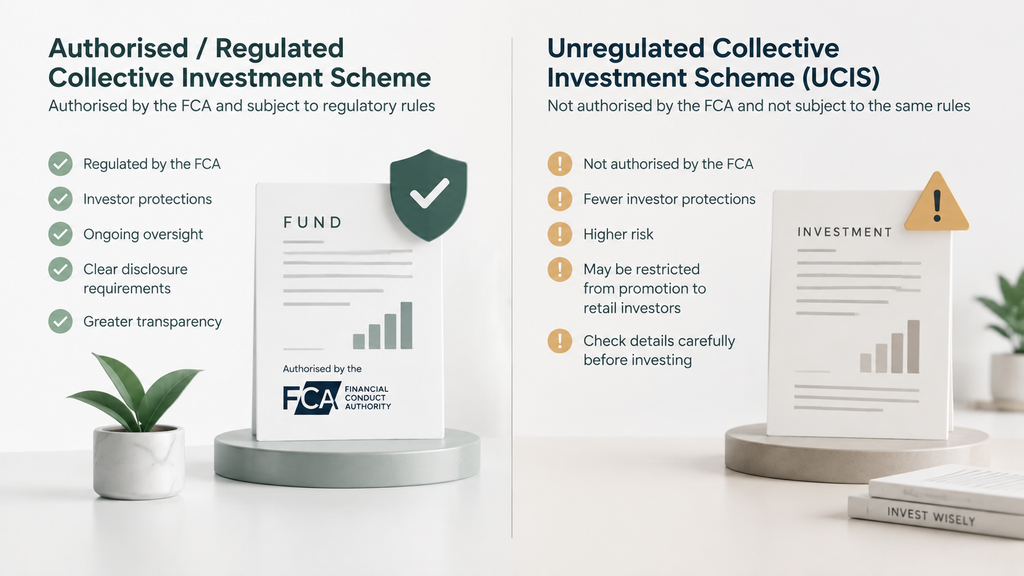
An authorised CIS is a scheme that has been authorised within the FCA framework.
As of August 2026, the FCA lists three main UK legal forms for authorised funds:
- Authorised contractual schemes (ACS)
- Authorised unit trusts (AUT)
- Investment companies with variable capital (ICVC)
These funds are then classified under categories such as UCITS, non-UCITS retail schemes, qualified investor schemes and long-term asset funds.
Authorisation matters because the fund must operate within a regulatory framework.
But authorisation is not a promise that the investment will make money.
An authorised fund can still fall in value. It can still hold risky assets. It can still charge fees. It can still underperform another fund.
Regulation and investment performance are separate questions.
What is an unregulated collective investment scheme?
An unregulated collective investment scheme is usually shortened to UCIS.
The FCA describes a UCIS as a CIS that has not been authorised by the FCA as a regulated UK scheme.
The word “unregulated” can be misunderstood.
It does not automatically mean the arrangement is illegal.
It means the scheme itself does not have the same authorised status and does not operate under the same fund rules as a mainstream regulated CIS.
That can make a major difference to investor protection.
In July 2026, the FCA updated its consumer guidance on UCIS and warned that these schemes can be highly speculative. They may invest in hard-to-value or illiquid assets such as hotel rooms, land, whisky or other unusual assets.
The FCA also warns that investors in a UCIS may not have the same protections they would expect from mainstream regulated investments.
Can a UCIS be promoted to ordinary investors?
Promotion is restricted.
The FCA’s rules are designed so that unregulated collective investment schemes are generally not promoted widely to ordinary retail investors.
There are exemptions and special circumstances, but a product appearing on a website or being sent to you in a message does not mean it is suitable for, or legally promotable to, everyone.
This matters because high-return private investment promotions often ask potential investors to confirm that they are sophisticated, experienced or high net worth.
Do not tick those boxes simply because they are standing between you and an investment you want to see.
The investor classification can affect the protections available to you.
The FCA has continued warning consumers about high-risk products offered by unregulated firms. In August 2026, it again warned that certain unregulated loan notes and mini-bonds should not normally be marketed widely to the public.
Does being a CIS mean an investment is safe?
No.
CIS is a structural and legal classification. It is not a risk rating.
A regulated collective fund holding short-term government bonds has a very different risk profile from an unregulated scheme investing in speculative property projects.
Before investing, you still need to look at the underlying assets.
Important risks can include:
- Market risk
- Liquidity risk
- Credit risk
- Concentration risk
- Manager risk
- Counterparty risk
- Valuation risk
- Fees and charges
- Regulatory risk
The structure can help you understand how the investment works, but it does not tell you whether the price is attractive or whether the investment belongs in your portfolio.
Collective investment scheme vs direct investment
A simple property example makes the distinction easier to see.
Suppose you buy a rental property yourself.
You choose the property, arrange finance, select tenants, organise repairs, collect rent and decide whether to sell.
You have direct ownership and day-to-day involvement.
Now imagine 100 people contribute money to an arrangement where one operator buys or controls property, handles the management and distributes income back to the participants.
That second arrangement looks much more like collective investment.
The exact legal result still depends on the facts, but the difference is useful.
The key question is not only “Do I own something?”
It is also “Who really controls and manages the investment?”
How to check a collective investment scheme before you invest
A fund prospectus can run to hundreds of pages, but you can learn a lot by answering a smaller set of questions first.
Who operates the scheme?
Find the exact legal name of the operator or fund manager.
Do not rely on a trading name or logo.
Then check the firm’s status using the FCA’s official Firm Checker or Financial Services Register where applicable.
What exactly are you buying?
Are you buying units in a fund, shares in a company, a contractual interest, a lease, a loan note or something else?
The name of the product and the legal rights you receive are not always the same thing.
What assets does the scheme actually own?
A property fund and a technology-stock fund are both pooled investments, but their risks are very different.
If the underlying assets are unusual, ask how they are valued and how frequently they can be sold.
Where does your return come from?
This question is especially important when a product advertises a fixed return.
Is the money coming from rent, interest, dividends, asset sales, business revenue or something else?
If the promoter cannot explain this clearly, the headline yield tells you very little.
Can you get your money out?
Liquidity often matters more than investors expect.
A listed fund may trade every business day. A private property or alternative-asset scheme may have no easy secondary market.
Read the redemption terms before you invest, not after you decide you want your money back.
What are the total fees?
Look beyond one management fee.
There may also be platform fees, performance fees, administration charges, dealing costs, adviser fees or expenses inside the underlying assets.
For long-term investors, small annual charges can compound into a meaningful difference. You can use our compound interest calculator to compare how different assumptions affect an investment over time, although the calculator does not model fund fees automatically.
What happens if the operator fails?
Ask who legally owns the assets, who holds them and what happens if the manager, operator or another key party becomes insolvent.
This is particularly important with unusual property and private investment structures.
Is the fund authorised or recognised?
Use official FCA records rather than relying on the promoter’s own wording.
An overseas fund promoted to UK retail investors may need to be recognised rather than authorised in the UK.
The distinction is technical, but the practical point is simple: verify the regulatory status yourself.
Are collective investment schemes good investments?
Some are. Some are not.
The phrase “collective investment scheme” is too broad to answer that question on its own.
A low-cost diversified authorised fund could be a sensible core holding for one investor.
A concentrated or illiquid private scheme could be completely inappropriate for the same person.
The right questions are more specific:
What does the scheme own?
How much does it cost?
How easy is it to sell?
How volatile are the assets?
What protections apply?
Does the investment fit the rest of your portfolio?
For someone who has never invested before, the answer may be to start simpler. Our guide on how to start investing with $1,000 covers the first decisions around goals, diversification, risk and fees before moving into more specialised investments.
Where collective investment schemes fit within alternative investing
Collective structures are especially common when investors want access to assets that would be difficult to buy individually.
Property is one example.
Private markets, infrastructure and other specialist assets can also be accessed through pooled structures.
That does not make every collective scheme an alternative investment. Many mainstream stock and bond funds are collective investments too.
The useful distinction is between the asset and the vehicle.
The asset tells you what the money is invested in.
The vehicle tells you how investors access and own that exposure.
Confusing those two things is an easy way to misread risk.
What changed for crypto staking in 2025?
UK law was amended in 2025 to address uncertainty around certain cryptoasset staking arrangements.
The Financial Services and Markets Act 2000 (Collective Investment Schemes) (Amendment) Order 2025 carved qualifying cryptoasset staking arrangements out of the CIS definition.
The government’s explanatory material said the change was needed because pooled staking services can have characteristics that resemble collective investment schemes, even though the CIS regime was not designed for blockchain validation services.
This is an important reminder that CIS law is not static.
An older article that simply says “pooled crypto staking is a collective investment scheme” may now be wrong or incomplete.
The precise structure still matters, and crypto regulation in the UK continues to evolve.
A practical checklist before investing
Before putting money into a CIS or any similar pooled arrangement, make sure you can answer these questions:
- What exactly am I buying?
- What assets sit underneath the investment?
- Who operates and controls the scheme?
- Do investors have day-to-day control?
- How is the return generated?
- Are investor contributions or returns pooled?
- Is the property managed as a whole?
- How can I sell or redeem the investment?
- What fees will I pay?
- Is the scheme authorised, recognised or unregulated?
- Is the person promoting it allowed to do so?
- What protections apply if something goes wrong?
- What happens if the operator fails?
If you cannot get clear answers, that is useful information in itself.
A complicated investment does not become safer because the brochure looks professional.
Frequently asked questions
What is a collective investment scheme?
A collective investment scheme is a legal category under UK financial services law covering certain arrangements where participants receive profits or income connected with property but do not have day-to-day control over its management. The arrangement must also involve pooling, management of the property as a whole, or both.
What does CIS mean in investing?
CIS stands for collective investment scheme. In the UK, the term has a specific legal meaning under Section 235 of the Financial Services and Markets Act 2000.
Is a mutual fund a collective investment scheme?
Many pooled fund structures can fall within the CIS framework, but the exact classification depends on the legal vehicle and jurisdiction. “Mutual fund” is used more commonly in countries such as the United States, while UK investors often see structures such as OEICs and unit trusts.
Is an ETF a collective investment scheme?
An ETF can be structured through a collective investment vehicle, but ETF and CIS are not the same definition. ETF describes a type of exchange-traded fund. CIS is a legal classification under UK financial services law.
Is a property investment a CIS?
It can be. Directly owning and managing your own property is different from taking part in an operator-managed arrangement involving several investors. The classification depends on how the scheme is structured and managed.
What is a UCIS?
UCIS stands for unregulated collective investment scheme. These schemes do not have the same authorised status as mainstream FCA-authorised collective funds and are generally subject to tighter restrictions on promotion to ordinary retail investors.
Are UCIS illegal?
Not automatically. An unregulated scheme is not necessarily unlawful simply because it is unregulated. However, establishing, operating, managing or promoting a scheme can involve regulated activities and legal restrictions. Investors should check the specific arrangement and the permissions of the firms involved.
Are collective investment schemes FCA regulated?
Some are authorised by the FCA, while overseas schemes may be recognised for promotion in the UK. Others are unregulated. Do not assume all schemes have the same status.
What happened in FCA v Forster?
The High Court found that care-home investment arrangements linked to the Qualia group amounted to an unauthorised collective investment scheme. The FCA said around £57 million had been taken from 380 investors. Investors had bought leasehold interests in care-home rooms and were promised returns of 8% to 10% a year.
Can a CIS promise a fixed return?
A scheme may promise a fixed contractual return, but that does not make the return risk-free and does not automatically take the arrangement outside the CIS definition. The underlying structure and economic effect still matter.
How do I check whether an investment firm is authorised?
Use the FCA Firm Checker or Financial Services Register and search the firm’s exact legal name. Check the permissions listed, not just whether the name appears somewhere on the register.
Final takeaway
A collective investment scheme is not simply “a fund where lots of people pool their money.”
That is a useful starting description, but UK law goes further.
The real test looks at the arrangements, the property involved, the way investors participate in profits or income, whether they have day-to-day control and whether contributions or returns are pooled or the property is managed as a whole.
FCA v Forster shows why that matters in practice. Investors were buying interests in specific care-home rooms, yet the High Court still found the overall arrangement to be an unauthorised CIS.
For investors, the useful habit is not memorising Section 235.
It is learning to ask better questions.
Who controls the assets?
Where does the return come from?
Can you get your money back?
What does the operator charge?
What regulatory status applies?
Those questions are often more revealing than the investment’s name.
If your goal is simply to start building a long-term portfolio rather than evaluate a specialist scheme, begin with the basics first. Our long-term investing guide for beginners explains how time horizon, diversification, fees and risk fit together before you move into more complex products.
Sources & References

Ritik
Ritik Kungwani is the founder and editor of SmartGrowthInvest, where he writes and oversees content on investing, personal finance, business ideas and practical money tools. His focus is on turning complex financial topics into clear, actionable guidance for readers in the United States, United Kingdom, Canada and Australia. Ritik started SmartGrowthInvest to make financial education more accessible, cutting through jargon and hype to help readers understand the tradeoffs behind investing decisions, side income opportunities, and everyday money management. He oversees the site's editorial standards, including source verification and content review, as outlined in the Editorial Policy. Outside of writing, Ritik focuses on researching market trends, testing financial tools and calculators, and refining how the site presents country-specific financial information. Contact: ritikvanved@gmail.com
View author profile →