
Starting a business sounds exciting until you sit down and ask yourself one simple question:
“What business should I actually start?”
For many aspiring entrepreneurs, this is where the journey stops.
They want independence. They want to create something of their own. They want to build another source of income.
But they cannot think of a single business idea.
The common mistake is believing successful entrepreneurs discover ideas through sudden inspiration.
Most businesses are not created because someone wakes up with a revolutionary idea.
They are created because someone notices a problem, understands a group of customers, and builds a better solution.
If you want to start a business but have no ideas, you do not need more random brainstorming.
You need a process.
This guide explains how to find business ideas by looking at your skills, problems around you, customer needs, and opportunities that already exist.
You Do Not Need a Completely New Business Idea
One of the biggest misconceptions about entrepreneurship is that your idea must be something nobody has ever seen before.
It does not.
A business does not succeed because it is completely original.
It succeeds because it solves a problem better, faster, cheaper, or more conveniently.
Think about common businesses:
- Cleaning services
- Accounting firms
- Fitness coaching
- Digital marketing agencies
- Online education
- Home repair services
None of these invented a new human need.
They simply found people who needed help and created a reliable solution.
A better question is not:
“Has this idea been done before?”
The better question is:
“Can I serve a specific customer better than existing options?”
Many beginners waste months searching for a unique idea when they should be looking for a useful one.
Why You Cannot Find a Business Idea
If you feel stuck, it usually happens for three reasons.
1. You are searching too broadly
“Start a business” is too big of a question.
Your brain has unlimited possibilities:
- Technology
- Food
- Retail
- Consulting
- Education
- Manufacturing
- Online businesses
The number of options creates confusion.
Instead, narrow the search.
Ask:
- What industries do I understand?
- What problems have I experienced?
- Who do I already know?
- What skills do I have?
2. You are looking for ideas instead of problems
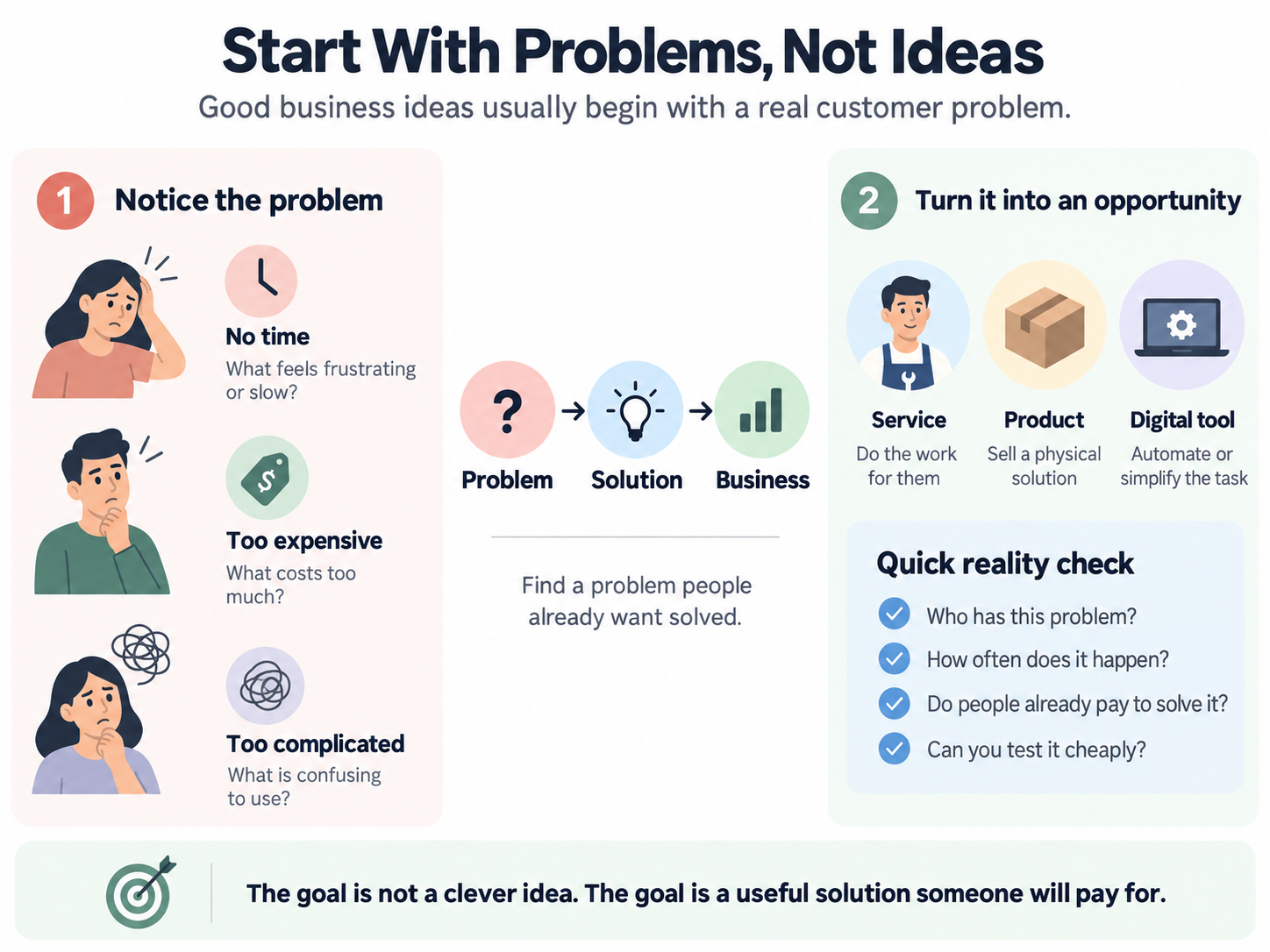
Customers do not buy ideas.
They buy solutions.
A business exists because someone has a problem.
Examples:
Problem:
Small companies do not know how to create online content.
Solution:
Content marketing service.
Problem:
Busy professionals do not have time to prepare healthy meals.
Solution:
Meal preparation business.
Problem:
Students struggle with career decisions.
Solution:
Career coaching service.
A good entrepreneur notices problems before creating products.
3. You expect your first idea to be perfect
Many people never start because they are waiting for certainty.
They think:
“When I find the perfect idea, I will begin.”
The reality:
Your first idea is often only the starting point.
You learn from customers.
You improve your offer.
You change direction.
Successful entrepreneurs often adjust their original idea after discovering what customers actually need.
Step 1: Start With Yourself – Find Your Skills and Knowledge
Your best business opportunities often come from things you already know.
Create three lists.
Skills
What can you do better than average?
Examples:
- Writing
- Sales
- Designing
- Teaching
- Organizing
- Repairing
- Managing people
- Marketing
Experience
What industries have you worked in?
Examples:
- Finance
- Healthcare
- Education
- Construction
- Technology
- Retail
Personal Knowledge
What topics have you spent years learning?
Examples:
- Fitness
- Cooking
- Photography
- Investing
- Parenting
- Travel
Something that feels normal to you may be valuable to someone else.
A person who has spent years understanding taxes, fitness, websites, or property may not realize that other people would pay for that knowledge.
Step 2: Find Problems People Are Willing to Pay For
Not every problem becomes a business.
The best opportunities usually have three elements:
The problem is painful
People actively want a solution.
Example:
“I wish my website looked better” is weaker than:
“I am losing customers because my website does not generate leads.”
The problem happens repeatedly
Recurring problems create stronger businesses.
Examples:
- Monthly bookkeeping
- Cleaning services
- Marketing services
- Maintenance
- Software subscriptions
People already spend money solving it
Existing spending proves demand.
Look at industries where people already pay.
Your opportunity may be improving the experience.
Step 3: Use the Problem-Solution Framework
Use this simple formula:
Customer + Problem + Solution = Business Opportunity
Example:
Customer:
Local restaurants
Problem:
They struggle to attract customers online.
Solution:
Local SEO and marketing service.
Customer:
Small business owners
Problem:
They do not understand financial reports.
Solution:
Monthly financial consulting.
Customer:
Busy parents
Problem:
They need convenient childcare activities.
Solution:
Educational activity subscription.
The strongest ideas usually come from the intersection of:
- What you know
- What people need
- What people pay for
Step 4: Choose the Right Business Model
Not every business idea requires the same investment.
Choose a model that matches your situation.
Service Business
Best for beginners.
Examples:
- Consulting
- Freelancing
- Coaching
- Marketing services
- Design services
Advantages:
- Low startup cost
- Faster first revenue
- Easy to test
Product Business
Examples:
- Ecommerce
- Physical products
- Handmade products
- Private label products
Advantages:
- More scalable
Challenges:
- Inventory
- Logistics
- Marketing costs
Digital Business
Examples:
- Online courses
- Templates
- Memberships
- Software tools
Advantages:
- Can scale globally
Challenges:
- Requires audience or marketing ability
For many first-time entrepreneurs, starting with a simple service is often easier because you can learn from customers before investing heavily.
Step 5: Validate Your Idea Before Spending Money
A common mistake:
Building first.
Testing later.
The safer approach:
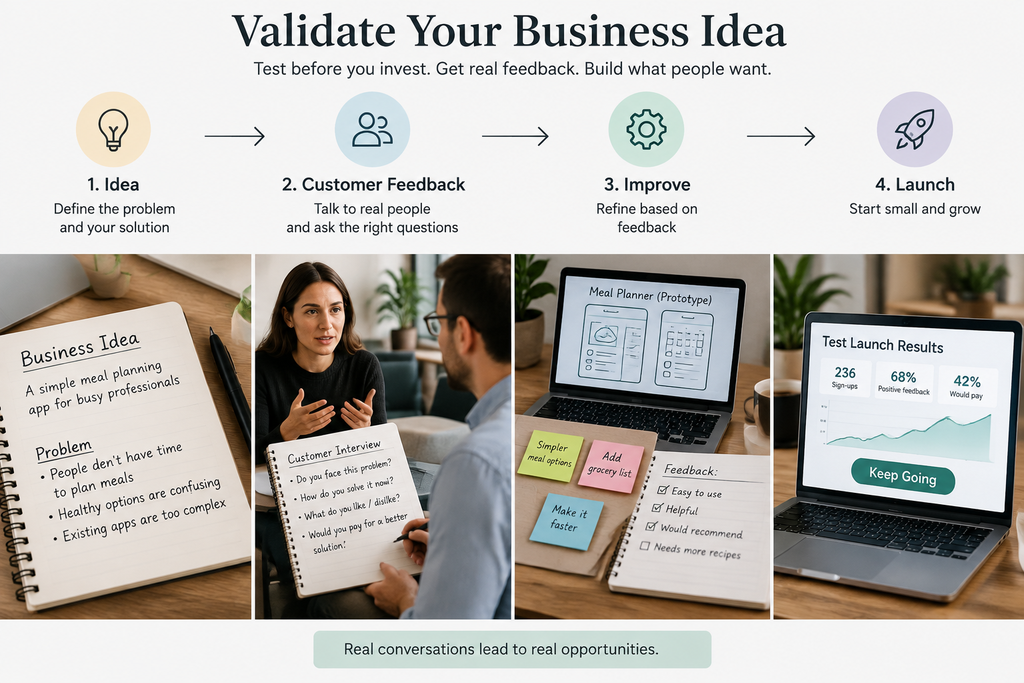
Validate first.
Before creating a website, buying inventory, or investing money, talk to potential customers.
Ask:
Question 1
“Do you currently have this problem?”
Question 2
“How are you solving it today?”
Question 3
“What does this problem cost you?”
Question 4
“Would you pay for a better solution?”
Good validation methods:
- Customer interviews
- Small pilot projects
- Landing pages
- Pre-orders
- Freelance tests
Your goal is not to prove your idea is perfect.
Your goal is to discover whether people care.
Step 6: Look Around You for Business Opportunities
Your daily life contains hundreds of problems.
Start observing.
Ask:
“What frustrates people?”
Examples:
A local business has poor online reviews.
Opportunity:
Reputation management service.
People struggle to understand insurance.
Opportunity:
Educational consulting.
Small companies waste time doing repetitive tasks.
Opportunity:
Automation service.
Many successful businesses start from ordinary problems.
The opportunity is hidden inside inconvenience.
Business Ideas You Can Explore If You Have No Starting Point
These are not guaranteed businesses.
They are examples of models you can adapt.
Online Service Businesses
- Content writing
- Social media management
- Website services
- Virtual assistant services
- Consulting
- Online tutoring
Local Service Businesses
- Home cleaning
- Repair services
- Pet services
- Elder assistance
- Event services
Knowledge-Based Businesses
- Coaching
- Training
- Courses
- Career guidance
- Industry consulting
Product Businesses
- Niche ecommerce
- Custom products
- Subscription products
- Specialized tools
The important thing is not choosing a random idea.
The important thing is understanding:
Who is the customer?
What problem do they have?
Why would they choose you?
Common Mistakes New Entrepreneurs Make
Trying to Copy Trends
A trend does not automatically create a good business.
A trend still needs:
- Customers
- Demand
- Differentiation
Building Before Talking to Customers
Many founders spend months creating something nobody requested.
Talk first.
Build second.
Choosing an Idea Only Because It Looks Profitable
A profitable market is not enough.
You also need:
- Interest
- Ability
- Access to customers
Trying to Do Everything Alone
Building relationships matters.
Talk to:
- Customers
- Other founders
- Industry experts
Feedback saves time.
What To Do After Finding a Business Idea
Once you have an idea:
1. Research the market
Understand:
- Competitors
- Customers
- Pricing
- Demand
2. Create a simple offer
Explain:
Who you help.
What problem you solve.
What result you provide.
3. Find your first customers
Your first customers teach you more than research.
4. Improve continuously
Your first version will not be perfect.
Improve based on feedback.
If you are interested in building income streams beyond employment, explore our guides on ways to make money online and business ideas for more opportunities.
Frequently Asked Questions
Can I start a business if I have no ideas?
Yes. Many businesses begin by identifying existing problems rather than creating completely new inventions.
What is the easiest business to start with no money?
Service businesses are usually easier because they require skills and time instead of inventory.
Examples:
- Freelancing
- Consulting
- Tutoring
- Marketing services
How do I find a profitable business idea?
Find the intersection between:
- Your skills
- Customer problems
- Market demand
Then test the idea before investing heavily.
Should I quit my job to start a business?
Not always.
Many entrepreneurs start part-time, validate demand, and transition when the business becomes more stable.
How long does it take to find a business idea?
There is no fixed timeline.
Some ideas appear quickly.
Others come after weeks of researching problems and talking with customers.
Final Thoughts
If you want to start a business but have no ideas, do not wait for inspiration.
Start observing.
Look at problems.
Use your existing skills.
Talk to people.
Test small.
A successful business does not begin with the perfect idea.
It begins with understanding someone else’s problem and creating a solution they value.
The goal is not to discover a magical idea.
The goal is to find an opportunity and take the first step.

Ritik
Ritik Kungwani is the founder and editor of SmartGrowthInvest, where he writes and oversees content on investing, personal finance, business ideas and practical money tools. His focus is on turning complex financial topics into clear, actionable guidance for readers in the United States, United Kingdom, Canada and Australia. Ritik started SmartGrowthInvest to make financial education more accessible, cutting through jargon and hype to help readers understand the tradeoffs behind investing decisions, side income opportunities, and everyday money management. He oversees the site's editorial standards, including source verification and content review, as outlined in the Editorial Policy. Outside of writing, Ritik focuses on researching market trends, testing financial tools and calculators, and refining how the site presents country-specific financial information. Contact: ritikvanved@gmail.com
View author profile →