

Someone searching for startup business ideas in Canada usually has two questions hiding inside the search:
What can I start?
and
Which idea has a realistic chance of becoming a business instead of an expensive hobby?
Those are different questions.
Canada has a deep small-business economy. Innovation, Science and Economic Development Canada reported 1,079,188 small employer businesses as of December 2024, equal to 98.2% of all employer businesses in the country. More than three out of four employer businesses had fewer than 10 employees. That matters because starting small is normal in Canada. You do not need a national brand, a warehouse or a large team on day one.
There is also renewed interest in self-employment. BDC reported in February 2026 that about two million Canadians work for themselves, after self-employment rebounded in 2024.
That does not mean every new business idea will work. It means there is room for businesses that solve a real problem and are priced well enough to survive.
This guide focuses on ideas that can be started at different budget levels. Some can begin with a laptop and a few clients. Others need equipment, insurance, licences or staff.
If you are comparing other ways to build income, SmartGrowthInvest also covers broader business ideas and ways to make money.
Quick comparison: startup business ideas in Canada
The cost ranges below are rough planning estimates, not quotes. A business in Toronto can face very different rent, insurance and labour costs from the same business in a smaller city. Equipment quality also changes the number quickly.
| Business idea | Rough startup cost | Format | Revenue model | Scalability |
|---|---|---|---|---|
| AI workflow consulting | C$500-C$5,000 | Online / hybrid | Project fees + retainers | High |
| Bookkeeping services | C$500-C$3,000 | Online / hybrid | Monthly retainers | Medium to high |
| Niche digital marketing agency | C$500-C$5,000 | Online | Retainers + project fees | High |
| Residential or commercial cleaning | C$1,000-C$8,000 | Offline | Recurring service fees | High |
| Mobile car detailing | C$2,000-C$15,000 | Offline | Per service + memberships | Medium |
| Property maintenance | C$2,000-C$20,000 | Offline | Project + recurring contracts | High |
| Senior support services | C$1,000-C$10,000 | Offline | Hourly + recurring plans | Medium to high |
| Online tutoring | C$300-C$3,000 | Online / hybrid | Hourly + packages | Medium |
| Pet services | C$500-C$8,000 | Offline / hybrid | Service fees + packages | Medium |
| Renovation or skilled trade business | C$5,000-C$50,000+ | Offline | Project fees | High |
| Niche e-commerce brand | C$2,000-C$25,000 | Online | Product sales | High |
| Commercial photography and video | C$2,000-C$15,000 | Hybrid | Project fees + retainers | Medium to high |
| Micro-SaaS product | C$1,000-C$30,000+ | Online | Subscription | Very high |
| Catering or specialty food business | C$3,000-C$40,000+ | Offline / hybrid | Product + event sales | Medium to high |
| B2B consulting or fractional services | C$500-C$5,000 | Online / hybrid | Retainers + project fees | High |
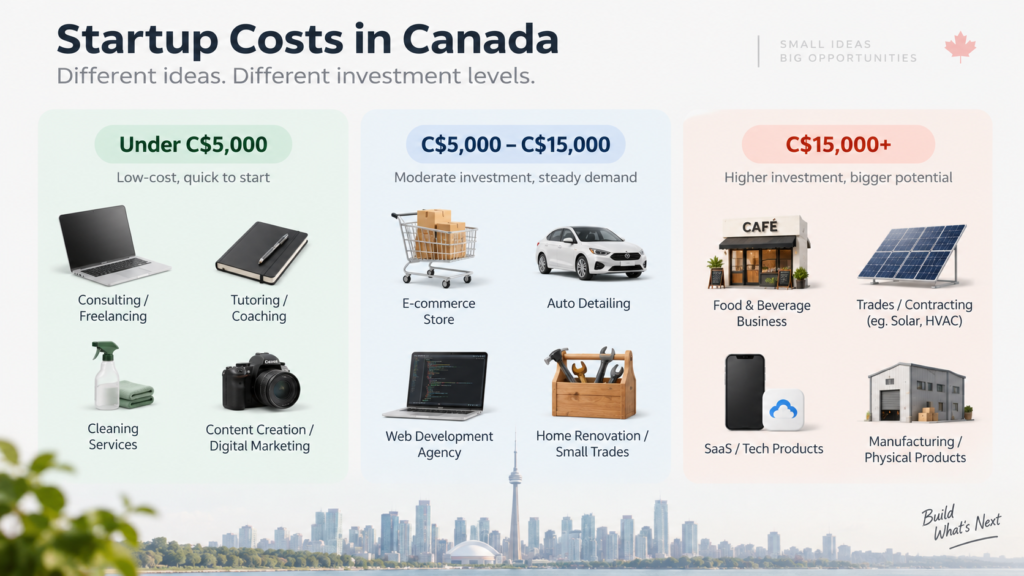
How to choose a business idea before you spend money
A long list is easy to publish. Choosing one idea is harder.
Before worrying about a logo, corporation name or website, test the business against five questions.
Is there a customer you can describe clearly?
“Everyone” is not a customer segment.
A cleaning company might serve busy dual-income households in one part of Calgary. A digital agency might work only with dental clinics. A bookkeeping service might specialize in independent tradespeople.
A narrower customer usually makes the first sales easier because you know where to find people and what problem to talk about.
Can you reach those customers without spending heavily?
A business can have a large market and still fail because customer acquisition costs too much.
A local service can often start through referrals, neighbourhood groups, partnerships and direct outreach. An e-commerce company may need paid advertising, content, marketplaces or an existing audience.
The cheaper your first customer is to reach, the more room you have to learn.
Does the price leave enough margin?
Revenue is not profit.
A C$200 service can look attractive until you subtract labour, travel, software, payment fees, supplies, insurance, marketing and tax.
Work backwards from the price. If the numbers only work when everything goes perfectly, the business model is fragile.
Are the legal requirements manageable?
Canada does not have one universal set of startup requirements.
Registration, licences and permits can depend on your structure, province or territory, municipality and activity. The federal government’s business registration guidance covers corporations, sole proprietorships and partnerships. BizPaL can generate a location-specific list of permits and licences from federal, provincial, territorial and municipal governments.
Can the business eventually work without every dollar depending on your own time?
A solo consulting business can be excellent, but it has a natural ceiling if every sale requires one hour of your personal work.
Recurring contracts, staff, standardized services, digital products and software can all increase scalability.
You do not need to scale immediately. You should at least know whether the business has a path beyond your calendar.
15 startup business ideas in Canada
AI workflow consulting for small businesses
AI consulting is crowded at the headline level, but there is still a practical gap between “businesses have access to AI” and “businesses know how to use it well.”
BDC reported in June 2026 that 96% of Canadian SMEs use at least one digital technology, while generative AI was being used by about three in ten Canadian businesses. Only 23% of SMEs scored high or very high on digital maturity.
That gap creates room for a service business focused on implementation rather than hype.
You could help a specific type of business automate:
- lead follow-up,
- customer support triage,
- appointment reminders,
- internal knowledge searches,
- document summaries,
- quotation workflows,
- recurring reporting,
- CRM updates.
The useful version of this business is not “I sell AI.”
It is “I reduce a task that currently takes your team eight hours a week.”
Estimated startup cost: C$500-C$5,000
Difficulty: Medium
Time requirement: Part-time or full-time
Skills required: Process mapping, AI tools, automation, client communication
Revenue model: Setup projects, audits and monthly support retainers
Scalability: High
Where the opportunity is
Start with one industry. An automation package for dental clinics is easier to explain and sell than generic automation for “any small business.”
BDC’s 2026 research suggests the bottleneck is increasingly execution rather than awareness. That gives a specialist who understands both workflows and technology something concrete to sell. citeturn809097search2turn809097search6
Main risk
Do not sell systems you cannot maintain or promise cost savings you have not measured. Businesses also need to think carefully about privacy, security and what data goes into third-party tools.
Bookkeeping and financial admin services
A lot of small-business owners are good at their actual trade and bad at keeping their paperwork current.
That creates a recurring service opportunity.
A bookkeeping business can offer:
- transaction categorization,
- bank reconciliation,
- accounts receivable follow-up,
- accounts payable organization,
- monthly management reports,
- payroll administration support,
- document organization for the client’s accountant.
This works best when you choose a niche. A bookkeeper who understands construction contractors, restaurants or independent health professionals can build better processes than one trying to serve every type of company.
Estimated startup cost: C$500-C$3,000
Difficulty: Medium
Time requirement: Part-time to full-time
Skills required: Bookkeeping, accounting software, accuracy, confidentiality
Revenue model: Monthly retainer
Scalability: Medium to high
Where the opportunity is
Recurring revenue.
A business owner does not need bookkeeping once. They need it every month.
Over time you can standardize the process, hire staff and move into higher-value reporting.
Main risk
Do not present yourself as a CPA or offer regulated professional services unless you hold the required credentials. Keep the scope of work clear.
Niche digital marketing agency
“Start a marketing agency” is weak advice.
“Help independent physiotherapy clinics turn local search traffic into booked consultations” is a business idea.
The difference is focus.
A small agency can sell:
- local SEO,
- paid search management,
- landing pages,
- email campaigns,
- content production,
- CRM setup,
- lead reporting,
- review-generation systems.
The advantage is low equipment cost. The hard part is proving that your work creates revenue instead of impressions and likes.
Estimated startup cost: C$500-C$5,000
Difficulty: Medium
Time requirement: Part-time or full-time
Skills required: Marketing, analytics, copy, sales
Revenue model: Monthly retainers and projects
Scalability: High
A better way to start
Pick one customer type, one result and one channel.
For example:
Google Ads and landing pages for independent HVAC contractors.
That is easier to package, price and improve than offering every form of marketing to everyone.
Main risk
Client churn. If your customer cannot see what the work is doing for the business, the retainer is easy to cut when money gets tight.
Residential or commercial cleaning
Cleaning is not glamorous, but that is part of why it can be a useful business.
Customers already understand what they are buying.
You do not need to educate the market about why clean homes, offices or rental properties matter.
Potential niches include:
- recurring residential cleaning,
- move-in and move-out cleaning,
- office cleaning,
- post-construction cleaning,
- short-term rental turnover,
- clinic or professional-office cleaning.
Estimated startup cost: C$1,000-C$8,000
Difficulty: Low to medium
Time requirement: Part-time or full-time
Skills required: Reliability, quality control, scheduling, customer service
Revenue model: Per visit and recurring contracts
Scalability: High
Where the opportunity is
Recurring work.
A one-time deep clean is useful cash flow. A customer every two weeks is a business asset.
A commercial cleaning contract can be even more predictable, though sales cycles may be longer.
Main risk
Labour management becomes the real business once you hire. Quality has to stay consistent when you are no longer doing every job yourself.
Mobile car detailing
A mobile detailer sells convenience as much as cleaning.
Instead of the customer spending part of the day driving to a detailing shop and waiting, you go to the home or workplace.
You can start with interior cleaning and basic exterior packages, then move into higher-ticket services if you have the training and equipment.
Estimated startup cost: C$2,000-C$15,000
Difficulty: Medium
Time requirement: Part-time or full-time
Skills required: Detailing, customer service, local marketing
Revenue model: Per-service packages and memberships
Scalability: Medium
How to make it less seasonal
Canadian weather matters.
A business built only around summer exterior detailing will feel very different in January. Interior detailing, fleet work, dealer relationships and prepaid maintenance packages can help reduce seasonality.
Main risk
Travel time can eat the margin. Tight service areas and route planning matter.
Property maintenance and seasonal home services
Canada’s seasons create recurring household work.
Depending on your skills and local rules, a property-service business could focus on:
- lawn care,
- snow clearing,
- gutter cleaning,
- pressure washing,
- minor exterior maintenance,
- seasonal property checks,
- rental-property turnover support.
The attractive part is that one homeowner can buy several services during the year.
Estimated startup cost: C$2,000-C$20,000
Difficulty: Medium
Time requirement: Part-time to full-time
Skills required: Equipment operation, scheduling, quoting, customer service
Revenue model: Per job and annual service plans
Scalability: High
A stronger model
Instead of selling snow removal in winter and hunting for a different business in summer, build a year-round property-maintenance company.
That lets the same customer buy repeatedly.
Main risk
Equipment, insurance, weather and staffing can all create costs before revenue arrives.
Non-medical senior support services
Canada’s aging population creates demand for help that sits outside medical treatment.
A non-medical support service might help with:
- companionship,
- grocery trips,
- transportation,
- household organization,
- appointment accompaniment,
- technology help,
- routine check-ins.
This is a trust business.
Families care about reliability, background checks, communication and continuity.
Estimated startup cost: C$1,000-C$10,000
Difficulty: Medium
Time requirement: Part-time to full-time
Skills required: Patience, communication, scheduling, trust-building
Revenue model: Hourly fees and recurring service plans
Scalability: Medium to high
Important boundary
Do not casually turn this into medical or personal-care work.
Health care, home care and related services may face provincial rules, professional requirements and insurance obligations. Define exactly what you do and verify the requirements where you operate.
Main risk
Hiring. Clients often want to see the same trusted person, which makes staff selection and retention important.
Online tutoring and skills coaching
Tutoring can start with knowledge you already have.
Possible niches include:
- math and science,
- English or French language support,
- test preparation,
- coding,
- music,
- university subjects,
- professional software,
- career-specific technical skills.
A teacher in Vancouver can work with a student in Halifax without renting a classroom.
Estimated startup cost: C$300-C$3,000
Difficulty: Low to medium
Time requirement: Part-time or full-time
Skills required: Subject expertise, teaching, communication
Revenue model: Hourly sessions, packages, small groups and courses
Scalability: Medium
How to improve the economics
One-to-one tutoring is limited by your time.
Small groups, structured programs, recorded material and hired tutors can increase revenue without increasing your personal hours at the same rate.
Main risk
A broad tutoring offer competes heavily on price. A clear niche usually helps.
Pet care services
Pet businesses work because the need is recurring.
Possible services include:
- dog walking,
- pet sitting,
- home visits,
- basic grooming,
- pet transportation,
- puppy check-ins,
- specialized care for older animals.
Estimated startup cost: C$500-C$8,000
Difficulty: Low to medium
Time requirement: Part-time to full-time
Skills required: Animal handling, reliability, scheduling, customer service
Revenue model: Per visit, recurring packages and add-on services
Scalability: Medium
Where the value is
Trust and convenience.
A customer who trusts you with a pet and access to their home is not likely to switch providers to save a few dollars.
That can make repeat business strong when service is reliable.
Main risk
Insurance, animal safety and scheduling need more attention than the low startup cost suggests.
Renovation or skilled trade business
Construction is one of the largest concentrations of small businesses in Canada. ISED counted 154,179 small employer businesses in construction as of December 2024.
For someone with the right trade, experience and credentials, a specialized local business can be more defensible than a generic online startup.
Possible directions include:
- painting,
- flooring,
- drywall,
- carpentry,
- energy-efficiency upgrades,
- specialized renovation,
- electrical work,
- plumbing,
- HVAC-related services.
Some of these activities require licences, certification or permits.
Estimated startup cost: C$5,000-C$50,000+
Difficulty: Medium to high
Time requirement: Full-time
Skills required: Trade skill, estimating, project management, sales
Revenue model: Project fees and maintenance contracts
Scalability: High
Where small operators can compete
Speed, specialization and reputation.
A small contractor does not need to beat a large company at everything. It can become the obvious choice for one type of job in one local market.
Main risk
Bad estimating can destroy the margin. Labour, materials, rework and schedule overruns have to be priced before the job begins.
Niche e-commerce brand
E-commerce is easy to start badly.
Opening a store is simple. Finding a product people repeatedly buy at a price that covers inventory, shipping, returns and customer acquisition is the actual work.
Better starting points include:
- a product designed for a specific hobby,
- supplies for a trade or profession,
- specialty Canadian-made goods,
- replenishment products,
- a tightly focused private-label product,
- a local retail business with online ordering.
Estimated startup cost: C$2,000-C$25,000
Difficulty: Medium to high
Time requirement: Part-time to full-time
Skills required: Product selection, merchandising, marketing, operations
Revenue model: Product sales and subscriptions where appropriate
Scalability: High
Start with proof, not inventory
Before buying a large shipment, test whether customers actually want the product.
Small initial quantities, pre-orders where appropriate, marketplace tests and direct customer interviews are cheaper than learning from a garage full of unsold stock.
Main risk
Cash gets trapped in inventory.
A business can show accounting profit and still run into trouble if too much cash is sitting in products that are not selling.
Commercial photography and short-form video
Businesses need visual content more frequently than they did when a photographer might be hired once a year.
A small content studio can specialize in:
- real-estate photography,
- restaurant content,
- product photography,
- corporate interviews,
- event coverage,
- short-form social video,
- recurring content days for local businesses.
Estimated startup cost: C$2,000-C$15,000
Difficulty: Medium
Time requirement: Part-time or full-time
Skills required: Photography, video, editing, sales
Revenue model: Project fees and monthly content retainers
Scalability: Medium to high
The better model
Recurring commercial work.
A wedding photographer starts from zero for each new customer. A restaurant group or real-estate brokerage can need content every month.
Main risk
Equipment can become an excuse to overspend. Clients pay for results, reliability and usable content, not your camera collection.
Micro-SaaS or vertical software
Software has one of the highest scalability ceilings on this list, but it is not automatically an easy business.
The strongest small software companies often solve an unglamorous problem for a narrow industry.
Examples:
- quoting software for a trade,
- scheduling for a specialized service,
- compliance document tracking,
- reporting tools,
- niche inventory management,
- workflow software for a professional practice.
Estimated startup cost: C$1,000-C$30,000+
Difficulty: High
Time requirement: Part-time initially or full-time
Skills required: Product thinking, development, customer research, sales
Revenue model: Monthly or annual subscription
Scalability: Very high
A useful way to validate it
Sell the problem before building the full product.
Talk to 20 potential users. Ask how they solve the problem now, what it costs them and what they have already tried.
A problem people complain about but will not pay to fix is not enough.
Main risk
Building before selling.
Six months of development can produce a technically good product that nobody urgently needs.
Catering or specialty food business
Food businesses can work well when the founder has a specific product, audience or local advantage.
Possible models include:
- corporate lunch catering,
- event catering,
- specialty baked goods,
- meal prep,
- cultural or regional foods,
- packaged specialty products,
- pop-ups and market stalls.
Estimated startup cost: C$3,000-C$40,000+
Difficulty: Medium to high
Time requirement: Part-time or full-time
Skills required: Food production, costing, safety, sales, operations
Revenue model: Product sales, event orders and catering contracts
Scalability: Medium to high
Regulation matters here
Food is one category where you should research requirements before buying equipment.
The Canadian Food Inspection Agency says licensing under the Safe Food for Canadians Regulations depends on the activities a business conducts. For example, businesses that import food or prepare food for export or interprovincial trade may require a federal licence. Provincial and municipal rules can also apply.
Main risk
Food margins can disappear through waste, labour and delivery. Cost every menu item before deciding whether the selling price is attractive.
B2B consulting or fractional services
If you already have valuable professional experience, consulting may be the shortest path from skill to revenue.
You could provide:
- fractional finance support,
- operations consulting,
- HR support,
- procurement consulting,
- sales operations,
- project management,
- compliance support,
- industry-specific advisory work.
Estimated startup cost: C$500-C$5,000
Difficulty: Medium
Time requirement: Part-time or full-time
Skills required: Deep subject knowledge, communication, sales
Revenue model: Retainers, day rates and project fees
Scalability: High if standardized or team-based
Why this can work
You are selling expertise that took years to build rather than buying inventory.
A consultant who understands one costly business problem can often charge based on the value of solving it.
Main risk
A vague consultant is difficult to buy.
“Operations consultant” is broad.
“I help 20- to 100-person construction companies reduce job-costing errors” tells a buyer what you actually do.
Best low-cost startup business ideas in Canada
If your budget is under about C$5,000, the lowest-cost ideas on this list tend to be skill-based services.
The most realistic candidates are:
| Idea | Why startup cost can stay low |
|---|---|
| Consulting | You are primarily selling existing expertise |
| Online tutoring | Laptop, software and marketing may be enough |
| Bookkeeping | Mostly software, training and client acquisition |
| Digital marketing | Low equipment requirement |
| AI workflow consulting | Mostly software, learning and sales |
| Pet services | Can begin solo with limited equipment |
| Cleaning | Basic supplies and insurance can be enough to test demand |
Low cost does not mean easy.
A C$500 service business can still fail because nobody buys it.
The advantage is that you can test the idea before committing large amounts of capital.
Best online startup ideas in Canada
If you want a business that can operate beyond your city, look first at:
- AI workflow consulting
- Digital marketing
- Bookkeeping
- Tutoring
- Micro-SaaS
- B2B consulting
- Niche e-commerce
Online businesses can have lower premises costs and broader reach, but they also compete with businesses outside Canada.
That makes specialization more important.
A local snow-removal company competes mainly with other local providers. A generic online marketing freelancer may compete with thousands of people around the world.
Which Canadian business ideas are most scalable?
Scalability is not the same as profitability.
A solo consultant may be highly profitable but difficult to scale if every client needs the founder.
Software can scale to thousands of customers, yet spend years losing money.
For this list, the models with the clearest scaling paths are:
- micro-SaaS,
- niche e-commerce,
- digital agencies,
- AI implementation services,
- cleaning and property services with teams,
- trade businesses with crews,
- specialized consulting that can be standardized and delegated.
The common feature is that revenue can eventually grow faster than the founder’s personal working hours.
How much money do you need to start a business in Canada?
There is no useful national number.
A home-based consultant and a food company with commercial equipment are both “startups,” but their capital requirements have almost nothing in common.
Think about startup cost in four buckets.
One-time setup costs
These can include:
- incorporation or registration,
- legal or accounting advice,
- equipment,
- tools,
- website,
- initial inventory,
- branding,
- deposits.
Monthly operating costs
Examples:
- software,
- rent,
- phone and internet,
- insurance,
- advertising,
- vehicle costs,
- wages,
- contractors.
Working capital
This is the cash needed while you wait to be paid.
A business that pays staff every two weeks but waits 45 days for customers to pay can grow quickly and still run out of cash.
Personal runway
The business may not replace your income immediately.
If possible, separate household emergency savings from business cash. A business becomes much harder to manage when every slow month threatens rent or mortgage payments.
How to start a business in Canada
The exact process depends on where you live and what you do, but these are the basic decisions.
Choose the business structure
The Canada Revenue Agency lists sole proprietorship, partnership and corporation as the main business structures for tax reporting purposes. Your structure affects tax filing and other legal and administrative matters.
Do not incorporate simply because “real businesses are corporations.”
A sole proprietorship may be simpler for an early test. A corporation can make sense for other reasons. The decision deserves tax and legal advice when the amounts or risks become meaningful.
Register where required
The Government of Canada notes that registration requirements depend on business type and where the business operates.
Check licences and permits
Use BizPaL to identify permits and licences that may apply at federal, provincial, territorial and municipal levels.
BizPaL itself notes that its database may not include every requirement, so use it as a starting point rather than the only compliance check. citeturn769530search3
Understand GST/HST registration
For most businesses, the CRA’s small-supplier threshold is generally C$30,000 in worldwide taxable supplies, subject to the detailed rules on how the threshold is calculated and exceptions. A business that stays under the threshold may still be able to register voluntarily if eligible.
Do not wait until tax season to learn how this works.
How to validate an idea before you spend heavily
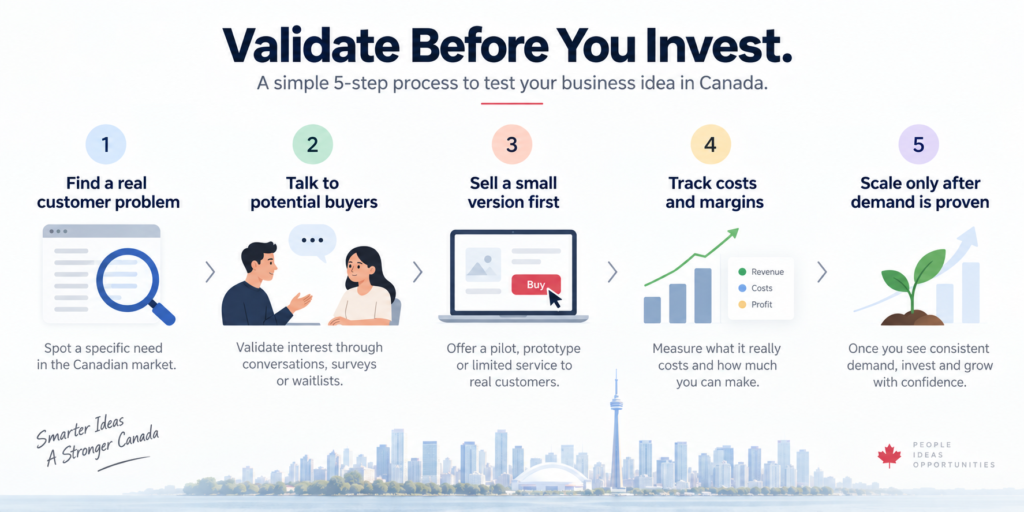
You can learn more from five paying customers than from fifty hours of logo design.
A simple validation process looks like this.
Talk to potential customers
Do not ask:
“Would you use a service like this?”
People are polite.
Ask:
“How do you solve this problem now?”
“What is frustrating about the current option?”
“What did you pay the last time?”
“What would make you switch?”
Those questions reveal behaviour rather than compliments.
Try to sell a small version
Before building the full agency, app, store or service menu, sell one clear offer.
For example:
C$299 one-time Google Business Profile cleanup for independent restaurants.
or
Four weekly Grade 10 math tutoring sessions for C$180.
A real payment tells you more than a survey response.
Keep the first test cheap
You do not need custom software if a spreadsheet works for the first five customers.
You do not need a leased office if clients are happy to meet online.
You do not need 500 units of inventory if you have not sold 20.
Delay fixed costs until demand gives you a reason to add them.
Track the numbers from the beginning
At minimum, know:
- revenue,
- direct cost per sale,
- gross margin,
- monthly overhead,
- customer acquisition cost,
- repeat purchase rate,
- how long customers take to pay.
You do not need an elaborate dashboard.
You do need to know whether the business is improving.
Common mistakes when starting a business in Canada
Choosing a trend instead of a customer
AI is a trend.
Helping a small accounting firm reduce document-processing time is a customer problem.
Start with the problem.
Spending before proving demand
A polished website feels productive because you can see it.
Customer conversations are less comfortable, which is why founders often postpone them.
Reverse the order.
Ignoring provincial and municipal rules
Canada’s business environment is not one national rulebook.
Childcare, food, trades, home businesses, signage, zoning and professional services can all involve local or provincial requirements.
Check before committing money.
Underpricing labour
Owners often calculate materials and forget their own time.
If a job takes four hours, the business has four hours of labour cost even when the founder has not started paying themselves properly.
Treating revenue as personal income
Money entering the business account may still need to cover tax, payroll, inventory, refunds, rent, software and future bills.
Keep business records clean from the start.
Scaling before the process works
Hiring does not fix a broken offer.
Advertising does not fix poor margins.
More customers do not fix weak cash flow.
First make the small version work.
Which startup idea should you choose?
You do not need the “best business in Canada.”
You need a business that fits your actual position.
Choose a service business if you have limited capital and a useful skill.
Choose a local recurring service if you prefer practical work and can build trust in one area.
Choose e-commerce if you understand a product niche and can handle inventory and customer acquisition.
Choose software if you have a real problem to solve and the patience to validate before building.
Choose consulting if your work experience gives you knowledge that businesses already pay for.
The most useful filter is this:
Can you name the first 20 people or businesses you would try to sell to?
If the answer is no, the idea is still too abstract.
Frequently asked questions
What is a good startup business idea in Canada for a beginner?
A service business based on a skill you already have is often easier to test than a capital-heavy business. Examples include tutoring, bookkeeping, cleaning, consulting, pet services or digital marketing. The important part is finding customers willing to pay, not choosing the idea with the lowest theoretical startup cost.
What business can I start in Canada with C$1,000?
Depending on your existing equipment and local requirements, possibilities can include consulting, tutoring, freelancing, basic digital services, bookkeeping or some pet services. Keep the first version narrow and spend as little as possible before proving demand.
What are some online business ideas in Canada?
Digital marketing, bookkeeping, AI workflow consulting, tutoring, consulting, niche e-commerce and micro-SaaS can all operate primarily online. Online reach does not guarantee easy customer acquisition, so specialization is important.
What businesses are growing in Canada?
There is no single list of guaranteed growth businesses. Current Canadian business trends include AI and digital adoption, ongoing demand for local services, a large base of small professional businesses and opportunities created by business ownership transitions. BDC’s 2026 research has focused heavily on productivity, digital transformation and AI adoption among SMEs.
Can a newcomer start a business in Canada?
Business ownership and the right to work in Canada are separate issues. Immigration status can affect whether and how a person may work in the business. Check current federal immigration rules and obtain professional advice where needed rather than assuming that registering a company automatically creates work authorization.
Do I need to register for GST/HST immediately?
Not necessarily. For most businesses, the general small-supplier threshold is C$30,000 in taxable supplies, but the calculation rules and exceptions matter. Businesses can also sometimes register voluntarily. Check the current CRA rules for your circumstances.
Do I need a licence to start a home business?
Possibly. Requirements can depend on your province, territory, municipality and activity. Zoning, food preparation, childcare, professional services and other activities may carry specific rules. Start with BizPaL and your local government.
Final takeaway
Canada has more than a million small employer businesses, but that does not mean the safest route is copying what everybody else is doing.
A practical startup begins with a customer and a problem.
If you have very little capital, sell a skill or service before buying inventory.
If you want a local business, look for work customers need repeatedly.
If you want an online business, narrow the customer enough that your offer does not disappear into global competition.
If you want something highly scalable, accept that software and product businesses usually require more testing before they produce reliable cash flow.
The first goal is not to build a huge company.
It is to get one offer in front of real customers, make the economics work and learn whether the demand is strong enough to earn the next investment.
For more location-specific content, browse SmartGrowthInvest’s Canada guides.

Ritik
Ritik Kungwani is the founder and editor of SmartGrowthInvest, where he writes and oversees content on investing, personal finance, business ideas and practical money tools. His focus is on turning complex financial topics into clear, actionable guidance for readers in the United States, United Kingdom, Canada and Australia. Ritik started SmartGrowthInvest to make financial education more accessible, cutting through jargon and hype to help readers understand the tradeoffs behind investing decisions, side income opportunities, and everyday money management. He oversees the site's editorial standards, including source verification and content review, as outlined in the Editorial Policy. Outside of writing, Ritik focuses on researching market trends, testing financial tools and calculators, and refining how the site presents country-specific financial information. Contact: ritikvanved@gmail.com
View author profile →