
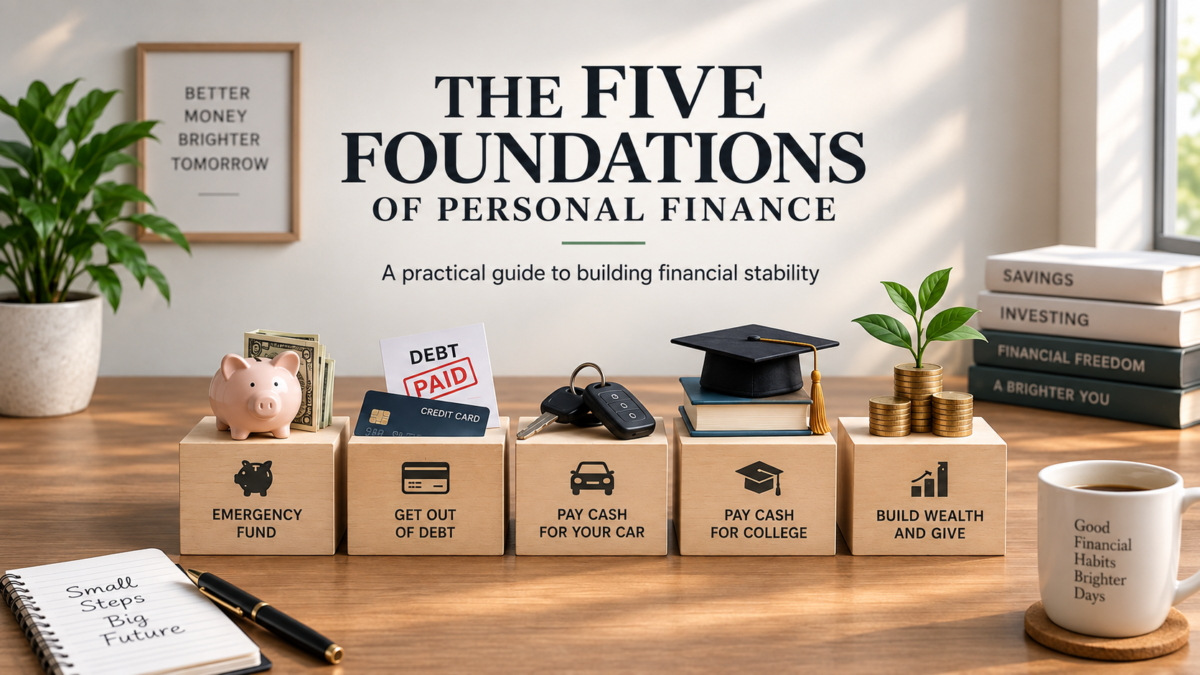
If you search for the five foundations of personal finance, you are usually looking for a specific framework taught by Ramsey Education.
The five foundations are:
- Save a $500 emergency fund
- Get out of debt
- Pay cash for your car
- Pay cash for college
- Build wealth and give
That is the short answer.
The more useful answer is that these five steps were designed as a simple money framework, particularly for students learning personal finance. They are not an official government standard, and they are not the only way financial planners organize personal finance.
That distinction matters.
A teenager with no rent, no children and no mortgage may be able to treat $500 as a meaningful starter emergency fund. An adult supporting a family may need a much larger cash reserve. Paying cash for a car can reduce borrowing costs, but draining your emergency savings to avoid a modest auto loan can create a different problem. Paying for college without debt is an excellent goal, but grants, scholarships, work-study and carefully evaluated federal aid also belong in the conversation.
So this guide does two things.
First, it explains the Five Foundations exactly as the framework is commonly taught.
Then it shows how to use the underlying ideas in real life without treating every number or rule as universal.
If you are building your finances from the ground up, that second part is where the framework becomes genuinely useful.
The five foundations at a glance
| Foundation | Core idea | Practical goal |
|---|---|---|
| 1. Save a $500 emergency fund | Build a small cash buffer before a surprise turns into debt | Keep emergency cash available and separate from everyday spending |
| 2. Get out of debt | Stop interest payments from consuming future income | Prioritize expensive consumer debt and avoid adding unnecessary new debt |
| 3. Pay cash for your car | Avoid turning transportation into a long-term monthly obligation | Save before buying and compare the total cost of borrowing if financing is necessary |
| 4. Pay cash for college | Reduce or avoid student loan debt | Use savings, grants, scholarships, work-study and lower-cost education options before borrowing |
| 5. Build wealth and give | Move from financial defense to long-term growth | Save and invest consistently, prepare for retirement and give according to your priorities |

Ramsey Solutions currently describes these as the Five Foundations in its financial-literacy material for students. Its March 2025 update still lists the same sequence: a $500 emergency fund, getting out of debt, paying cash for a car, paying cash for college, and building wealth and giving. Ramsey Solutions: The Five Foundations
The order is intentional. The first four steps are mainly about keeping unexpected costs and large purchases from becoming debt. The fifth is where the focus shifts toward long-term wealth.
Foundation 1: Save a $500 emergency fund
The first foundation is to save $500 for emergencies.
The idea is simple. Before trying to invest, buy a car or aggressively pursue another long-term goal, have some cash available for the small emergencies that are guaranteed to show up eventually.
A flat tire is not a retirement problem.
A broken phone screen is not an investment problem.
A minor medical bill should not automatically become credit card debt.
A starter emergency fund gives you another option.
Why $500?
In Ramsey Education’s Five Foundations material, the $500 target is aimed largely at students. For someone still in high school or just beginning to manage money, $500 can be enough to absorb several common surprises without borrowing.
For an adult household, however, $500 should usually be viewed as a starting point rather than a finished emergency fund.
The Consumer Financial Protection Bureau does not prescribe one emergency-fund amount for everybody. Instead, it says the amount you need depends on your situation and recommends thinking about the unexpected expenses you have faced in the past and what they cost. CFPB: Building an emergency fund
That is a more useful way to size your cash reserve.
Someone living with parents and driving a paid-off car has different risks from a homeowner with two children, one income and an older HVAC system.
What should an emergency fund cover?
A genuine emergency fund is for costs you did not plan into the normal monthly budget.
Examples include:
- An urgent car repair
- An unexpected medical bill
- A broken appliance
- Emergency travel
- A temporary loss of income
- An essential home repair
Annual insurance premiums, holiday gifts and a vacation are not emergencies if you know they are coming.
Those belong in separate savings categories.
Where should you keep emergency savings?
Accessibility matters more than maximizing returns.
For many U.S. households, a separate savings account at an FDIC-insured bank is a straightforward option. FDIC insurance generally covers eligible deposits to at least $250,000 per depositor, per insured bank, for each account ownership category. FDIC: Deposit Insurance
The account should be easy enough to reach in a genuine emergency but separate enough that you are not constantly spending from it.
How to apply Foundation 1
If you have no emergency savings, do not get stuck debating whether your ultimate target should be three months or six months of expenses.
Start smaller.
Your first goal could be $500 because that is the original foundation.
Once you reach it, look at your actual financial risks and build beyond it.
For example:
- First target: $500
- Next target: one month of essential expenses
- Longer-term target: an amount that reflects your income stability, dependents, insurance coverage and likely emergencies
The lesson behind Foundation 1 is more important than the exact number:
Give yourself enough cash that every surprise does not become new debt.
Foundation 2: Get out of debt
The second foundation is to get out of debt.
Ramsey’s version of the framework emphasizes the debt snowball: list debts from smallest balance to largest balance, make minimum payments on all of them, and direct extra money toward the smallest balance first.
When that balance is gone, roll the payment into the next one.
The appeal is psychological. You get an early win and see the list shrink.
There is another common strategy called the debt avalanche, where you pay extra toward the debt with the highest interest rate first. Mathematically, that approach generally minimizes interest if you follow it consistently.
Neither approach changes the central point:
High-interest consumer debt can make it difficult to build wealth because part of every future paycheck is already committed to past spending.
Investor.gov puts this bluntly in its guidance on building wealth: no investment offers a guaranteed return high enough to offset high-interest credit card debt. Investor.gov: Build Wealth Over Time
Which debts deserve the most attention?
Not every debt has the same cost.
A credit card charging a high APR is different from a low-rate fixed mortgage.
A payday loan is different from a federal student loan.
A promotional 0% balance that expires in several months is different from a personal loan carrying a double-digit rate.
Before deciding what to pay first, write down:
- Balance
- Interest rate
- Minimum payment
- Remaining term
- Whether the rate can change
- Any penalties or special conditions
That gives you a real picture of what the debt is costing.
Snowball or avalanche?
Use the method you can follow.
If small wins keep you motivated, the snowball can be practical even if it does not minimize interest in every case.
If you are disciplined and want to reduce interest cost, the avalanche can be more efficient.
What matters most is that you stop adding avoidable high-interest debt while paying down the balances you already have.
Should you stop all investing while paying off debt?
This is where a rigid rule can become less helpful.
If your employer offers a 401(k) match, giving up the entire match while repaying moderate-rate debt may have a meaningful opportunity cost. If you have 25% credit card debt, the calculation looks very different.
The Five Foundations provide a sequence, but real financial decisions still depend on the interest rate, employer benefits, taxes, cash reserves and your ability to stick with the plan.
The useful principle is:
Do not try to build an investment portfolio while ignoring expensive debt that is compounding against you.
Foundation 3: Pay cash for your car
The third foundation is to pay cash for a car rather than financing it.
The logic is easy to understand.
Cars usually decline in value. Financing adds interest and fees to an asset that is already depreciating. A longer loan may make the monthly payment look easier while increasing the total amount paid.
The Consumer Financial Protection Bureau recommends comparing the total cost of an auto loan, not just the monthly payment. The total cost includes the amount financed plus interest and certain fees over the loan term. CFPB: How much can I afford to borrow for a car?
In a CFPB example using a $20,000 loan at 4.75%, a three-year term produces a much higher monthly payment than a six-year term, but the six-year loan results in more than twice as much total interest. The example is illustrative rather than a statement about current market rates. CFPB: Compare auto loan offers
Why paying cash can help
Buying with cash can:
- Eliminate loan interest
- Remove a monthly debt payment
- Reduce the risk of owing more than the car is worth
- Make the true purchase price harder to ignore
- Give you more monthly cash flow after the purchase
It can also encourage you to buy a less expensive vehicle.
When the money leaves your savings account immediately, a $38,000 vehicle feels like a $38,000 purchase.
When the conversation centers on a monthly payment, it is easier to focus on whether $620 fits the budget and forget about the total price.
But should everyone pay cash?
Not necessarily.
Suppose paying cash for a car would wipe out your emergency fund and leave you with $200 in the bank.
You have avoided an auto loan but created a fragile cash position.
Or suppose you can obtain low-cost financing, have stable income and already have enough cash reserves. Financing part of the purchase may be manageable.
That does not mean the Ramsey principle is wrong.
It means the underlying principle is more useful than treating “cash only” as a law.
The principle is:
Do not buy more car than you can afford, and do not judge affordability by the monthly payment alone.
A better car-buying checklist
Before buying, compare:
- Purchase price
- Down payment
- Loan APR
- Loan term
- Total interest
- Insurance
- Registration and taxes
- Fuel
- Maintenance
- Expected depreciation
If financing turns an affordable car into an expensive long-term commitment, step down in price.
Foundation 4: Pay cash for college
The fourth foundation is to pay cash for college.
Again, the core goal is debt avoidance.
Student loans can follow borrowers for years after graduation and reduce the amount of income available for housing, retirement savings, investing and other goals.
But “pay cash for college” should not be interpreted as “ignore financial aid unless you already have tuition sitting in a bank account.”
For a U.S. student, one of the most important steps is completing the FAFSA, because it can open access to federal grants, work-study and student loans, as well as some state and school aid. Federal Student Aid describes the FAFSA as the gateway to the largest source of federal student aid. Federal Student Aid: FAFSA steps
Use free or earned aid before loans
Federal Student Aid recommends evaluating aid in an order that starts with grants and scholarships, then work-study, before moving to student loans. Federal Student Aid: Evaluating aid offers
That makes sense because:
- Grants generally do not need to be repaid
- Scholarships generally do not need to be repaid
- Work-study provides earned income
- Loans have to be repaid, usually with interest
If you are trying to follow the spirit of Foundation 4, the question is not simply “Can I pay the sticker price in cash?”
The better question is:
How low can I get the net cost before I borrow anything?
Ways to reduce college borrowing
You may be able to reduce the amount borrowed by combining several approaches:
- Apply broadly for scholarships
- Complete the FAFSA every year
- Compare net price, not only published tuition
- Consider in-state public schools
- Start at a community college where appropriate
- Live at home if practical
- Work part time
- Use Federal Work-Study if eligible
- Choose a program with a realistic career payoff
- Ask whether an employer offers tuition assistance
- Save in advance through an appropriate education account
Federal Student Aid also recommends looking for scholarships through colleges, community groups, local organizations, businesses and other sources. Federal Student Aid: Scholarship tips
Are student loans always a mistake?
No single rule fits every student.
A modest federal student loan used to complete a high-value degree is not financially identical to borrowing a very large amount for a program with weak employment prospects.
If borrowing is necessary, understand:
- The exact amount borrowed
- Interest rate
- Whether interest accrues while you are in school
- Expected monthly payment
- Typical starting salary in the field
- Graduation rate
- Whether you are borrowing federally or privately
- Available repayment protections
The useful principle behind Foundation 4 is:
Treat borrowing as a cost to minimize, not as the automatic way to pay whatever a school charges.
Foundation 5: Build wealth and give
The first four foundations are mainly defensive.
Build a buffer.
Reduce debt.
Avoid unnecessary borrowing for a car.
Reduce or avoid student debt.
Foundation 5 changes the direction.
Now the goal is to build wealth and give.
This is where saving turns into long-term investing.
What does building wealth actually mean?

It does not require finding the next hot stock.
For most people, wealth is built gradually from a combination of:
- Consistently spending less than they earn
- Increasing income over time
- Saving for short-term goals
- Investing for long-term goals
- Using tax-advantaged accounts where appropriate
- Keeping investment costs under control
- Avoiding destructive debt
- Allowing investments time to compound
If you are new to investing, SmartGrowthInvest’s guide on how to start investing with $1,000 walks through the first decisions without assuming you already understand funds, stocks or portfolio construction.
Use retirement accounts intentionally
For U.S. investors, workplace retirement plans and IRAs can play an important role.
For 2026, the IRS says the employee contribution limit for 401(k), 403(b) and most governmental 457 plans is $24,500. The annual contribution limit for traditional and Roth IRAs is $7,500, subject to eligibility and income rules. IRS: 2026 retirement contribution limits
Those are maximum limits, not suggested targets.
You do not need to contribute $24,500 to make progress.
Someone starting with $100 per month is still investing.
Someone who increases a workplace contribution by 1 percentage point each year is still moving forward.
Consistency matters more than waiting until you can afford a perfect contribution.
See what compounding can do
If you want to test different contribution amounts, time periods and hypothetical returns, use the SmartGrowthInvest compound interest calculator.
The calculator is useful because it separates the amount you contribute from the growth assumption.
That helps answer a question many new investors have:
How much of the final balance comes from me, and how much comes from growth over time?
Remember that an assumed return is not a forecast. Actual investment returns vary and can be negative, particularly over shorter periods.
What about the “give” part?
Giving is part of Ramsey’s fifth foundation because the framework treats generosity as one use of financial capacity after you begin building wealth.
That is a personal value rather than a requirement for financial success.
Some people give regularly throughout their lives. Others increase charitable giving as their financial position improves. Some give money; others give time.
The financial planning point is to make generosity intentional rather than letting it conflict with essential bills or force you into debt.
If you claim a tax deduction for charitable giving, check current IRS rules and make sure the recipient is an eligible organization. Tax rules can change from year to year.
Are the Five Foundations the same as the five pillars of personal finance?
No.
This is one of the biggest sources of confusion around this search.
The Five Foundations described above are the Ramsey Education framework:
- Save $500
- Get out of debt
- Pay cash for a car
- Pay cash for college
- Build wealth and give
Other financial websites use the phrase five pillars of personal finance to describe something different.
A common version of the five pillars is:
- Income
- Expenses
- Savings
- Investments
- Insurance or protection
Falcon Wealth Planning, for example, organizes its five-pillar framework around income, spending, saving, investing and protection. Paladin Registry has published a similar broader personal-finance model. Falcon Wealth Planning: Five Pillars of Personal Finance Paladin Registry: Five Pillars
Neither framework is an official government definition of personal finance.
They simply organize the subject differently.
The Ramsey model is action-oriented and sequential.
The broader five-pillar model is category-oriented.
If your question is “What should I do next with my money?”, the Five Foundations can be easier to follow.
If your question is “What areas of my financial life should I manage?”, the five-pillar model may be more complete because it explicitly includes income, spending and insurance.
What the Five Foundations leave out
A simple framework is useful partly because it leaves things out.
That is also its weakness.
Real personal finance includes several issues that do not fit neatly into the five steps.
Budgeting
You cannot consistently save, repay debt or invest if you do not know where your money goes.
A budget does not have to mean tracking every coffee.
At minimum, know:
- Monthly take-home income
- Essential expenses
- Minimum debt payments
- Savings
- Variable spending
- Irregular annual expenses
That gives every other foundation a place in the cash flow.
Insurance
A $500 emergency fund will not solve a major uninsured medical event, a house fire or the loss of a breadwinner’s income.
Insurance transfers risks that would be too large for most households to absorb alone.
Depending on your circumstances, that can include:
- Health insurance
- Auto insurance
- Homeowners or renters insurance
- Disability insurance
- Life insurance
- Liability coverage
Taxes
Taxes influence retirement accounts, investments, college savings, charitable giving and business income.
You do not need to become a tax specialist, but ignoring taxes can make two otherwise similar financial choices produce very different results.
Estate planning
A will, beneficiary designations, powers of attorney and related documents become increasingly important as your assets and responsibilities grow.
Credit
The Ramsey framework strongly emphasizes avoiding debt, but credit reports and credit scores still affect many parts of U.S. financial life, including some mortgages, rental applications and insurance pricing.
Even if you prefer to minimize borrowing, understanding your credit profile is useful.
How to apply the Five Foundations in real life
The framework becomes easier to use when you stop viewing it as five slogans and start translating each one into a decision.
Imagine someone with:
- $3,800 monthly take-home pay
- $200 in emergency savings
- $4,500 on a high-interest credit card
- A reliable older car
- No student loans
- A workplace 401(k) with an employer match
A practical sequence might look like this.
Step 1: Build the first cash buffer
Bring emergency savings from $200 to at least $500.
That reduces the chance that the next car repair goes straight back onto the credit card.
Step 2: Attack the expensive debt
Keep minimum payments current and direct extra cash toward the credit-card balance.
Whether they use the snowball or avalanche method matters less here because there is only one major high-interest balance.
Step 3: Protect the progress
After the high-interest debt is gone, continue building the emergency fund beyond the initial $500 based on actual expenses and job stability.
Step 4: Prepare for known purchases
If the car is likely to need replacement in two years, start a dedicated car fund before it fails.
That is the practical meaning of “pay cash for your car.” The savings starts before the purchase.
Step 5: Invest for the future
Use the workplace retirement plan and other appropriate investment accounts.
If the employer offers a match, understand its rules and incorporate it into the plan.
Step 6: Add other goals
College savings, a home purchase, travel, charitable giving and other priorities can then be funded without losing sight of the basic financial structure.
This is not the only valid order.
It shows how the Five Foundations can become a working plan rather than a memorized list.
What if you cannot complete the foundations in order?
Real life does not always cooperate with a neat sequence.
You may be paying student loans while needing a car.
You may be investing enough to receive an employer match while paying off debt.
You may have children in college before your own retirement savings feel complete.
You may need to replace a vehicle before you have saved the full purchase price.
That does not mean the framework has failed.
Use it to identify the tradeoff.
If you must finance a car, can you buy a cheaper one, make a larger down payment or shorten the term?
If you need student loans, can you reduce the amount through grants, work-study or a lower-cost school?
If you are paying debt, can you still maintain enough cash to avoid borrowing again after the next emergency?
Good personal finance is often less about finding a perfect option and more about avoiding the expensive version of an imperfect situation.
Which foundation should you start with?
Start with the first weak point in your finances.
If you have no emergency savings, build the starter buffer.
If you already have cash but carry expensive credit card debt, debt is probably the bigger issue.
If you have no consumer debt and adequate emergency savings, your attention can shift toward planned purchases and long-term investing.
If college is approaching, compare net prices and aid packages before borrowing.
If your foundation is already solid, spend more time on investment contributions, retirement planning and other long-term goals.
The list is sequential, but your starting point depends on what you have already completed.
A practical checklist
Use this once a month until the basics feel automatic.
Emergency savings
- Do I have at least a starter cash buffer?
- Is the money separate from normal spending?
- Is my current emergency fund large enough for my actual risks?
- If I used the fund recently, am I rebuilding it?
Debt
- Do I know every balance and APR?
- Am I paying more than the minimum on expensive debt?
- Have I stopped adding avoidable new debt?
- Is my payoff strategy one I can actually follow?
Car
- Am I saving for my next vehicle before I need it?
- Am I comparing total purchase cost rather than only monthly payment?
- Would a car purchase wipe out my emergency savings?
- If I finance, do I understand the APR, term and total interest?
College
- Have I completed the FAFSA?
- Have I compared net prices?
- Have I searched for grants and scholarships?
- Have I considered work-study and lower-cost schools?
- If borrowing, do I understand exactly how much I will owe?
Wealth building
- Am I contributing consistently to long-term investments?
- Do I understand my workplace retirement plan?
- Do I know whether my employer offers a match?
- Are investment fees reasonable?
- Is my portfolio appropriate for my time horizon and risk tolerance?
Common mistakes when following the Five Foundations
Treating $500 as a permanent emergency fund
For a student, $500 can be substantial.
For many adult households, it is only the first layer of protection.
Use it as a starting target and then adjust based on your situation.
Paying off low-cost debt while ignoring a cash emergency
Being debt-free on paper does not help much if a $700 repair immediately sends you back to a credit card.
Keep enough liquidity to avoid repeatedly undoing your progress.
Buying a car with cash at any cost
Paying cash is not automatically smart if it empties every account you have.
The goal is to reduce debt without making your finances fragile.
Choosing a college before comparing the net price
The published tuition price is not always the amount a student pays after grants and scholarships.
Compare actual aid offers before deciding what is affordable.
Waiting too long to learn about investing
You do not need to become an expert before you can understand retirement accounts, diversification and compound growth.
Learning can happen while you work through the earlier foundations.
Thinking “build wealth” means chasing high returns
High returns usually come with higher risk.
Building wealth is more often about regular contributions, reasonable costs, diversification and time than finding an investment that suddenly multiplies your money.
Frequently asked questions
What are the five foundations of personal finance?
The Five Foundations popularized through Ramsey Education are: save a $500 emergency fund, get out of debt, pay cash for your car, pay cash for college, and build wealth and give.
Who created the Five Foundations?
The version commonly referred to as “The Five Foundations” is associated with Ramsey Education and Dave Ramsey’s financial-literacy curriculum.
Is $500 enough for an emergency fund?
It can be a useful starter target, especially for a student or someone beginning from zero. It is not necessarily enough for an adult household. The CFPB says an appropriate emergency-fund amount depends on your circumstances and the types of financial shocks you may face.
What is the second foundation of personal finance?
The second foundation is getting out of debt. Ramsey’s framework teaches the debt snowball method, which targets the smallest balance first while keeping minimum payments current on the other debts.
What is the third foundation of personal finance?
The third foundation is paying cash for a car. The goal is to avoid long-term auto debt and the interest cost that comes with financing a depreciating asset.
What is the fourth foundation of personal finance?
The fourth foundation is paying cash for college. In practice, U.S. students should also look at grants, scholarships, work-study, lower-cost schools and other forms of aid before taking on student loans.
What is the fifth foundation of personal finance?
The fifth foundation is building wealth and giving. This usually means consistently saving and investing for long-term goals while making charitable giving part of your financial plan if that aligns with your values.
Are the Five Foundations the same as Dave Ramsey’s Baby Steps?
No. They are related to the same debt-averse financial philosophy, but the Five Foundations are a separate simplified framework used in Ramsey Education’s student financial-literacy material.
Are the Five Foundations an official financial standard?
No. They are a financial-education framework. Government agencies, financial planners and other educators may organize personal finance differently.
What are the five pillars of personal finance?
There is no single official list, but a common five-pillar model uses income, expenses, savings, investing and insurance or protection. That is different from Ramsey’s Five Foundations.
Final takeaway
The Five Foundations work because they are easy to remember.
Keep some cash available.
Stop expensive debt from controlling your income.
Plan major purchases before they become loans.
Reduce the amount you have to borrow for education.
Then use the room you have created to save, invest and give.
That is a sensible direction.
The part worth adapting is the detail.
A $500 emergency fund may be enough for a teenager and too small for a parent with a mortgage. Paying cash for a car can be excellent, but not if it leaves you unable to handle a medical bill. Avoiding student loans is useful, but grants, scholarships, work-study and the actual value of the degree matter too.
Personal finance improves when the framework fits the household rather than the household being forced to fit the framework.
If you are already at the fifth foundation and want to begin investing, read How to Start Investing With $1,000. You can also use the SmartGrowthInvest Compound Interest Calculator to see how different contribution amounts, time periods and hypothetical returns change a long-term investment scenario.
Sources
- Ramsey Solutions, 5 Money Habits to Teach Your Students This Year
https://www.ramseysolutions.com/financial-literacy/5-money-habits-to-teach-your-students-this-year - Consumer Financial Protection Bureau, An Essential Guide to Building an Emergency Fund
https://www.consumerfinance.gov/an-essential-guide-to-building-an-emergency-fund/ - FDIC, Deposit Insurance
https://www.fdic.gov/resources/deposit-insurance - Investor.gov, Build Wealth Over Time Through Saving and Investing
https://www.investor.gov/build-wealth-over-time-through-saving-and-investing - Consumer Financial Protection Bureau, How Much Can I Afford to Borrow for a Car or Auto Loan?
https://www.consumerfinance.gov/ask-cfpb/how-much-can-i-afford-to-borrow-for-a-car-or-auto-loan-en-751/ - Consumer Financial Protection Bureau, How Do I Compare Auto Loan Offers?
https://www.consumerfinance.gov/ask-cfpb/how-do-i-compare-auto-loan-offers-what-should-i-look-at-besides-the-monthly-payment-en-753/ - Federal Student Aid, Steps for Students Filling Out the FAFSA Form
https://studentaid.gov/articles/fafsa-student-steps/ - Federal Student Aid, How to Evaluate Your Aid Offers
https://studentaid.gov/articles/evaluating-financial-aid-offers/ - Federal Student Aid, Scholarship Tips
https://studentaid.gov/articles/scholarship-tips/ - Internal Revenue Service, 401(k) limit increases to $24,500 for 2026, IRA limit increases to $7,500
https://www.irs.gov/newsroom/401k-limit-increases-to-24500-for-2026-ira-limit-increases-to-7500 - Falcon Wealth Planning, The 5 Pillars of Personal Finance
https://www.falconwealthplanning.com/falcon-articles/the-5-pillars-of-personal-finance/ - Paladin Registry, The 5 Pillars of Personal Finance and How to Become Adept at Managing Them
https://www.paladinregistry.com/blog/personal-finance/the-5-pillars-of-personal-finance-and-how-to-become-adept-at-managing-them/

Ritik
Ritik Kungwani is the founder and editor of SmartGrowthInvest, where he writes and oversees content on investing, personal finance, business ideas and practical money tools. His focus is on turning complex financial topics into clear, actionable guidance for readers in the United States, United Kingdom, Canada and Australia. Ritik started SmartGrowthInvest to make financial education more accessible, cutting through jargon and hype to help readers understand the tradeoffs behind investing decisions, side income opportunities, and everyday money management. He oversees the site's editorial standards, including source verification and content review, as outlined in the Editorial Policy. Outside of writing, Ritik focuses on researching market trends, testing financial tools and calculators, and refining how the site presents country-specific financial information. Contact: ritikvanved@gmail.com
View author profile →