What this guide helps you do
You do not need to understand stock charts, company balance sheets or complicated trading strategies before you start investing.
For a complete beginner, the first decision is simpler:
How long can you leave the money invested, how much of a drop could you tolerate without selling, and how much work do you want to do yourself?
For money you can leave alone for 10 years or more, a low-cost diversified stock index fund is often the simplest starting point. A target-date fund can be even easier when the goal is retirement and you want the fund to handle the mix of stocks and bonds for you. The right choice depends on your time horizon, risk tolerance, account and country.
The bigger mistake is trying to find the one investment that can never lose money. No long-term investment can promise that.
The SEC’s Investor.gov explains that investing involves risk and that returns are not guaranteed. It also points beginners toward regular investing, diversification, emergency savings and paying down high-interest debt before taking on more investment risk. (Investor.gov).
The simplest answer for a beginner
If you know almost nothing about investing, you probably do not need 10 different investments.
A reasonable starting structure looks like this:
| Situation | A simple place to start |
|---|---|
| Retirement and you want the least maintenance | A low-cost target-date fund |
| Long-term investing and you want control over the allocation | A broad stock-market index fund |
| Long-term goal but you know you cannot handle large market drops | A diversified stock-and-bond fund or a mix of stock and bond funds |
| Money you expect to need within about 5 years | Savings, money market funds, short-term government securities, CDs or other lower-volatility choices |
| You want to pick individual companies | Keep this as a smaller part of your portfolio after you understand the basics |
This is deliberately boring.
That is a feature, not a flaw.
Fidelity’s current guide to long-term investments lists stocks, bonds, CDs, target-date funds, mutual funds and ETFs among the main choices, while stressing that the investment should fit the time available and the investor’s risk tolerance. (Fidelity).
Vanguard similarly describes index funds as a straightforward way to get diversified market exposure, particularly for people who want a low-maintenance approach. (Vanguard).
First, do not invest money you may need soon
A beginner often starts by asking, “Which investment should I buy?”
A better question is, “When will I need this money?”
Those two questions lead to very different answers.
Suppose you are saving for a house deposit you expect to use in three years. Putting that money into a stock fund creates a problem. The stock market could be down when you need the cash, leaving you with a forced decision: delay the purchase or sell at a loss.
Now imagine the same money is for retirement 30 years away. A temporary market decline is much easier to absorb because you have time before the money is needed.
The SEC makes the same distinction between saving for near-term needs and investing for long-term goals. Its investor guidance recommends keeping emergency savings in a bank or credit union and investing regularly for long-term goals. (Investor.gov).
A useful rule of thumb
This is not a law, but it is a practical way to think about your first portfolio:
- Less than 5 years: be cautious with stock-market risk.
- 5 to 10 years: your mix depends heavily on the goal and how much volatility you can accept.
- 10+ years: you have more time to tolerate stock-market swings, so diversified stock funds become more reasonable for long-term growth.
Do not treat the five-year mark as a magic switch. Someone saving for a house in six years may still have a very different portfolio from someone investing for retirement in six years.
The date matters. So does the goal.
Before investing, get your financial base in order
Investing can help build wealth, but it should not come before every other financial priority.
Investor.gov specifically recommends dealing with high-interest credit card debt, building an emergency fund and creating room in your budget before making long-term investments. citeturn321707search2
That matters because a stock portfolio is a poor emergency fund.
Imagine you have $10,000 invested and your car breaks down, your hours at work get cut, or you receive an unexpected medical bill. If the market has also fallen 20%, you may have only $8,000 of investments available when you need the money. You have turned a temporary market loss into a permanent loss by selling because the cash was necessary.
Your emergency savings exist partly to prevent that situation.
What about high-interest debt?
This is one of the few beginner questions where the answer can be quite direct.
If you are carrying credit card debt at a high interest rate, paying that balance down can be more valuable than rushing into the stock market.
Investor.gov states that no investment can guarantee a return high enough to outweigh high-interest credit card debt. citeturn321707search2
You can still learn about investing while paying down debt. You do not have to choose between becoming financially literate and waiting to invest.
Why index funds are so useful for beginners
An index fund is a mutual fund or ETF designed to track a market index.
Instead of deciding that Apple is a better investment than Microsoft, or that one bank will outperform another, you own a fund that holds many securities according to its index.
That changes the job.
You are no longer trying to identify the next winning company. You are buying a broad slice of a market and accepting that some holdings will do poorly while others do well.
Vanguard says index funds can be particularly suitable for beginners because they provide broad market exposure at relatively low cost and require less hands-on management. citeturn292878search3turn292878search5
FINRA also recommends diversification and explains that spreading investments among and within asset classes can reduce the impact of a poor result from any single investment. (FINRA).
There is a catch
“Index fund” does not automatically mean “diversified.”
A fund tracking a narrow technology index is still an index fund.
A fund holding a broad range of companies across a large market is much more diversified.
That distinction is easy to miss when you are starting out.
A beginner should look at what the fund actually owns, not stop at the word “index.”
Should a beginner choose the S&P 500?
For a U.S. investor, an S&P 500 index fund is one common way to get exposure to large U.S. companies.
It can be a perfectly reasonable long-term holding.
But the S&P 500 is not the whole world.
It is made up of large U.S. companies, so a portfolio invested entirely in an S&P 500 fund is heavily tied to one country’s stock market and one segment of the global equity market.
That does not make it bad. It means you should understand what you are buying.
You may prefer a broader U.S. market index, a global stock index, or a combination of stock and bond funds depending on your goal.
For investors outside the United States, the local tax rules and available funds can also change the best implementation.
This is one reason we would avoid telling a global audience that one ticker symbol is the correct answer for everyone.
Target-date funds may be even easier
A target-date fund is built around an approximate future date, usually a retirement year.
The fund typically starts with a larger allocation to stocks and gradually shifts toward more conservative investments as the target date approaches.
Investor.gov specifically lists target-date funds as a useful option for investors who want automatic changes in their portfolio over time. citeturn321707search2
Fidelity describes the same approach: the target date influences the asset allocation, with the fund generally becoming more conservative as the date approaches. (Fidelity).
For a beginner, the appeal is obvious.
You do not have to decide every year whether your portfolio should be 80% stocks and 20% bonds, or 70% and 30%, or something else.
The fund does that work.
The downside
Target-date funds are not all the same.
Two funds aimed at the same retirement year can have different stock allocations, bond allocations, fees and underlying funds.
So “target-date fund” is a category, not a recommendation to buy the first one you see.
Before choosing one, check:
- The expense ratio
- The investment mix
- Whether it uses index funds or active funds
- How the allocation changes as retirement approaches
- Whether the fund is appropriate for your account
What about individual stocks?
This is where many beginners get pulled into investing too early.
A stock is a small ownership stake in a company. If the company grows and the market values it more highly, the share price may rise. If the business performs poorly or investors decide the shares are worth less, the price can fall.
The problem is concentration.
If you own one company and it has a major business problem, your entire investment in that company is exposed to the fallout.
A diversified fund spreads that company-specific risk across many holdings.
This does not mean individual stocks are forbidden.
You might eventually decide you enjoy researching companies and want to own a few yourself.
But there is no reason to make stock picking the foundation of your portfolio just because it feels more like “real investing.”
For a person starting from zero, learning how to save regularly, understand fees, use a diversified fund and stay invested through market declines is more useful than learning how to read a stock chart on day one.
FINRA advises new investors to understand what they are buying, learn about fees, diversify and avoid relying on hunches or hot tips. (FINRA).
What about bonds?
Bonds can play an important role in a long-term portfolio, especially when an investor has a shorter time horizon or wants to reduce the size of stock-market swings.
When you buy a bond, you are lending money to a government, company or other issuer under specific terms. You normally receive interest and eventually repayment of principal, although the outcome depends on the bond and issuer.
Bonds are not “safe” in every sense.
A bond can lose market value before maturity. Longer-maturity bonds can be particularly sensitive to changes in interest rates, and lower-quality corporate bonds carry greater default risk.
Fidelity makes the same point in its long-term investment guide, noting that long-term bonds can be less volatile than stocks while still carrying interest-rate and credit risks. (Fidelity).
For a young investor with a long retirement horizon, a 100% stock portfolio may be reasonable if that person can genuinely tolerate large declines.
For someone who knows they would panic and sell during a severe downturn, adding bonds may make the portfolio easier to hold.
That behavioral point is often more useful than arguing about the perfect percentage.
How much can a stock portfolio fall?
This is the question beginners should ask before they invest, not after.
A stock fund can lose a substantial amount of value during a market downturn.
That is normal stock-market risk.
The real test is what you would do if your $20,000 portfolio became $14,000 while the economic news looked terrible.
Would you keep contributing?
Would you leave the investment alone?
Or would you sell because you cannot stand seeing the account balance fall?
If the third answer feels likely, your portfolio may be too aggressive.
There is no prize for owning the highest-risk portfolio.
A portfolio that you can actually hold is more useful than one that looks impressive in a bull market and gets abandoned during a crash.
How compounding actually helps
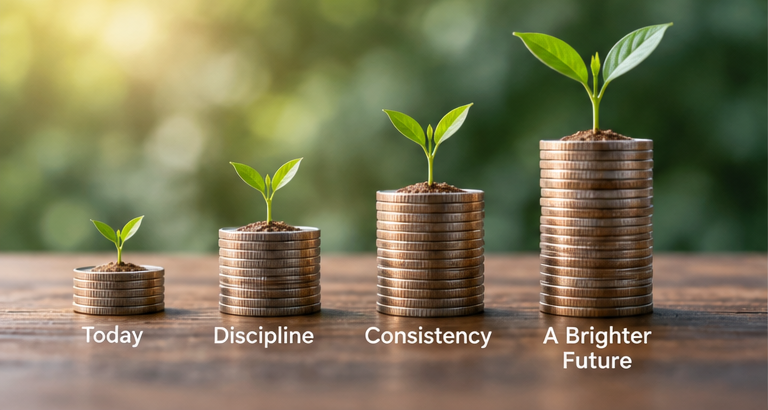
Long-term investing works partly because investment returns can themselves earn returns.
Suppose you invest $200 a month and earn an average 7% annual return, with monthly compounding for illustration.
After 30 years, the account would be about $244,000.
You contributed $72,000 of your own money.
The rest would come from investment growth.
At $500 a month, the same hypothetical 7% return over 30 years produces roughly $610,000, while your contributions total $180,000.
These numbers are illustrations, not forecasts.
Investor.gov uses 7% as an example assumption when demonstrating compound growth and notes that investments do not have a fixed rate of return. (Investor.gov)
The important lesson is not that 7% is what you will earn.
It is that time gives compounding more room to work.
A person who starts with a modest amount and keeps adding to it for decades can build a much larger balance than someone who waits for the “perfect” investment and spends years on the sidelines.
Should you invest a lump sum or invest every month?
Beginners often worry about choosing the exact right day to invest.
That can become a form of procrastination.
If you have money that is genuinely intended for a long-term goal and you have already dealt with your near-term cash needs, you have two common approaches.
Invest the money according to your plan
This means investing the amount you have available in line with your chosen allocation.
The advantage is that the money spends more time in the market.
Spread the investment over time
You could divide the amount into smaller purchases over several weeks or months.
This can feel easier emotionally because you are less exposed to the fear that you invested everything just before a market decline.
It can also become a problem if the gradual approach is really an excuse to keep waiting for a better entry point.
The better approach is the one you can follow consistently.
For ongoing income, automatic investing can make the process much easier. Investor.gov recommends regular contributions and gives 5% or 10% of income, or another affordable fixed amount, as examples of recurring contributions. citeturn321707search2
How much should a beginner invest?
There is no universal percentage that works for every household.
The right number is whatever you can invest consistently without sacrificing emergency savings, required bills and debt payments.
Someone earning $50,000 with high rent and debt may not be able to invest 20% of income.
Someone earning $100,000 with low expenses and no consumer debt may have much more flexibility.
A useful starting point is to choose an amount you can automate and then increase it as your income grows.
The amount matters.
So does the habit.
You can begin with $50 a month. You can begin with $100. You can invest more later.
The goal is to make investing part of the normal flow of your money rather than something you remember to do when the headlines are encouraging.
Where should the money go first in the United States?
For U.S. readers, the account can matter almost as much as the investment.
A workplace retirement plan such as a 401(k) may offer tax benefits and an employer match.
Investor.gov recommends considering a workplace retirement plan and an IRA when building a long-term investing plan. citeturn321707search2
For 2026, the IRS says the employee contribution limit for most 401(k), 403(b) and governmental 457 plans is $24,500. The annual contribution limit for traditional and Roth IRAs combined is $7,500, subject to the rules and income limits that apply to the account. (IRS).
That does not mean every beginner should rush to contribute the maximum.
It means you should understand the account options available before assuming a regular taxable brokerage account is your only choice.
For readers in the UK, Canada and Australia, the tax-advantaged account names and rules are different. The principle is the same: use the tax treatment available in your country when it fits your goal and circumstances.
Always check the current rules before acting because contribution limits, eligibility and tax rules can change.
What fees should a beginner watch?
Fees look tiny when you see them on a fund page.
They can become meaningful over decades.
An index fund charging 0.05% and another charging 0.50% may sound like a minor difference.
It is not.
The higher-cost fund has to overcome that extra cost every year before you receive your return.
Vanguard’s current index-fund material reports an average expense ratio of 0.04% for its index mutual funds and ETFs, compared with 0.17% for the industry average, based on asset-weighted data as of December 31, 2025. citeturn292878search7
That is not an argument that everyone should buy a Vanguard fund.
It is a useful reminder to compare expenses rather than assume every diversified fund costs roughly the same.
Also check for account fees, trading charges where applicable, advisory fees and fund-specific costs.
A fund’s historical return does not tell you what you will earn in the future.
Costs are one of the few things you can actually see in advance.
Common beginner mistakes
Buying whatever has gone up the most recently
A fund or stock that performed brilliantly last year may be expensive, concentrated or simply coming off a strong run.
Past performance does not tell you what will happen next.
Owning too many investments
Buying six different funds does not necessarily make you diversified.
If all six funds own the same large companies, you may have created six wrappers around the same exposure.
Checking your account every day
Long-term investing works on a different clock from a savings account.
Watching daily price movements can make a sensible long-term plan feel like an emergency.
Selling during a crash
Market declines are part of stock investing.
Selling during a fall may turn a temporary decline into a permanent loss and can make it difficult to participate in a later recovery.
Chasing dividend yield
A high dividend yield can look attractive, but a large yield does not automatically mean a safer investment or a better total return.
Look at the whole business or fund, not one number.
Trying to predict every market move
You will hear confident forecasts about recessions, rate cuts, elections, wars and the next big technology theme.
Some forecasts will be right.
That does not make them useful as a long-term portfolio strategy.
A beginner portfolio does not need to be complicated
Here are three examples to show how the choices can differ.
These are illustrations, not recommendations for a particular person.
Option 1: One-fund retirement approach
A target-date fund built for your expected retirement year.
This is useful for someone who wants the fund to handle diversification and gradually adjust the stock-and-bond mix.
Option 2: Simple stock approach
A low-cost broad-market stock index fund.
This is useful for someone with a long time horizon who accepts that the account can experience large temporary declines.
Option 3: Stock plus bonds
A diversified stock index fund combined with a bond fund.
This gives the investor more control over the risk level. Someone who wants fewer stock-market swings may hold a larger bond allocation, while someone with a long horizon and high risk tolerance may hold more stocks.
There is no correct portfolio that applies to every beginner.
The point is to choose a structure that you understand and can stick with.
What I would not make a beginner’s first investment
There are investments that can have a place in a more experienced investor’s portfolio but are poor starting points when you do not yet understand basic investing.
That can include leveraged products, highly speculative individual stocks, complex options strategies and investments you cannot explain in plain English.
Cryptocurrency deserves the same caution.
You may decide to own some after learning how it works and understanding the possibility of very large losses.
But “it could go up a lot” is not an investment thesis.
A beginner’s first investment should teach you good habits rather than force you to make difficult decisions you are not ready for.
A practical first-year plan
You do not need to master investing before putting your first dollar to work.
A better plan is to learn while following a simple process.
Month 1: Get the basics right
Work out your monthly expenses.
Build or strengthen your emergency savings.
Pay attention to high-interest debt.
Decide what the money is for and roughly when you will need it.
Month 2: Choose your account
Look at the retirement or investment accounts available where you live.
For U.S. employees, review your workplace retirement plan and employer match.
For everyone else, check the tax-advantaged accounts available in your country.
Month 3: Choose one simple investment
Compare broad index funds or target-date funds.
Look at what the fund owns, its expense ratio and its investment objective.
Do not buy three funds simply because three sounds safer than one.
Months 4 to 12: Make it automatic
Set a recurring contribution.
Review the portfolio occasionally rather than constantly.
Use the time to learn what you own.
Then increase your contribution when your income rises or your expenses fall.
That is a much more useful beginner habit than trying to find the perfect stock.
How can a beginner benefit from this approach?
The biggest benefit is that you reduce the number of decisions you have to get right.
You do not have to predict which company will win next year.
You do not have to know whether the market will rise next month.
You do not have to switch investments every time a financial headline changes.
Instead, you decide:
what the money is for, how long you can leave it invested, how much risk you can tolerate, what account you should use, and what low-cost diversified investment fits that plan.
Then you keep adding money.
That gives you a process you can repeat as your income grows.
It also gives you a simple way to spot bad advice. If someone is promising unusually high returns with little risk, telling you that a particular investment is guaranteed to rise, or pressuring you to act immediately, step back.
Investor.gov specifically warns beginners about guaranteed high returns, unregistered professionals and investment pitches spread through social media and group chats. citeturn321707search2
Frequently asked questions
Is an index fund good for someone who knows nothing about investing?
A broad, low-cost index fund can be a sensible starting point for a beginner because it can provide diversification without requiring you to select individual companies. You still need to understand what the fund tracks, what it costs and how much risk it carries.
Should I buy stocks or ETFs?
An ETF is a fund structure that can hold stocks, bonds or other assets. A stock is ownership in one company. For a beginner, a diversified ETF can reduce the risk that one company’s problems will damage the whole portfolio.
Is the S&P 500 enough for long-term investing?
It can be a reasonable U.S. equity holding, but it only covers large U.S. companies. Whether it is enough depends on how broadly you want to diversify across company sizes, asset classes and countries.
Is investing safe for the long term?
Long-term investing still involves risk. A diversified portfolio may reduce the damage caused by any one holding performing badly, but it cannot eliminate market losses.
How much money do I need to start investing?
You do not need a large portfolio to begin learning. Some funds and brokerages allow very small investments or fractional shares. The more useful question is whether the money is genuinely available for the goal and whether you can keep contributing.
Should I invest all my savings?
Usually, no. Money needed for emergencies and near-term expenses generally belongs in savings or other lower-volatility places rather than a stock portfolio. Your long-term investment account should contain money you can leave invested through market downturns.
What if I am scared of losing money?
That is normal.
Instead of trying to eliminate all investment risk, decide how much risk you can live with. A more conservative stock-and-bond mix may be easier to hold than an all-stock portfolio. The best allocation is the one you can follow through a bad market.
Should I wait for the next market crash?
Trying to predict the perfect entry point is difficult. A repeatable investment plan is usually easier to follow than waiting indefinitely for the market to give you a “better” price.
Final takeaway
You do not need to become a stock picker to become an investor.
For many beginners, the first sensible move is to build an emergency fund, deal with high-interest debt, choose an appropriate account and use a low-cost diversified fund that matches the time available and risk you can tolerate.
For retirement, a target-date fund can make the process even simpler.
For a long-term portfolio outside a retirement plan, a broad stock index fund can be a straightforward starting point for someone who understands that the balance will sometimes fall.
The investment is only one part of the decision.
Your time horizon, contribution habit, account, fees and ability to stay invested during a bad market will have a lot to do with whether the plan works for you.
Sources & References
- The following sources were used to research and fact-check this guide: U.S. Securities and Exchange Commission, Investor.gov, "Introduction to Investing": https://www.investor.gov/introduction-investing U.S. Securities and Exchange Commission, Investor.gov, "Build Wealth Over Time Through Saving and Investing": https://www.investor.gov/build-wealth-over-time-through-saving-and-investing FINRA, "Investing Basics": https://www.finra.org/investors/investing/investing-basics FINRA, "Asset Allocation and Diversification": https://www.finra.org/investors/investing/investing-basics/asset-allocation-diversification Fidelity, "7 Long-Term Investments," February 12, 2026: https://www.fidelity.com/learning-center/trading-investing/long-term-investments Vanguard, "What is an index fund?": https://investor.vanguard.com/investor-resources-education/understanding-investment-types/what-is-an-index-fund Vanguard, "Index Funds: How to Invest": https://investor.vanguard.com/investment-products/index-funds Vanguard, "How to open an account": https://investor.vanguard.com/investor-resources-education/how-to-open-account Internal Revenue Service, "401(k) limit increases to $24,500 for 2026, IRA limit increases to $7,500": https://www.irs.gov/newsroom/401k-limit-increases-to-24500-for-2026-ira-limit-increases-to-7500 Internal Revenue Service, "Retirement Topics - IRA Contribution Limits": https://www.irs.gov/retirement-plans/plan-participant-employee/retirement-topics-ira-contribution-limits NerdWallet, "Best Investments: Where to Invest in 2026," updated June 11, 2026: https://www.nerdwallet.com/investing/learn/the-best-investments-right-now Reddit, r/stocks, beginner investing discussion on long-term investing: https://www.reddit.com/r/stocks/ Reddit, r/investingforbeginners, recent beginner portfolio discussions: https://www.reddit.com/r/investingforbeginners/

Ritik
Ritik Kungwani is the founder and editor of SmartGrowthInvest, where he writes and oversees content on investing, personal finance, business ideas and practical money tools. His focus is on turning complex financial topics into clear, actionable guidance for readers in the United States, United Kingdom, Canada and Australia. Ritik started SmartGrowthInvest to make financial education more accessible, cutting through jargon and hype to help readers understand the tradeoffs behind investing decisions, side income opportunities, and everyday money management. He oversees the site's editorial standards, including source verification and content review, as outlined in the Editorial Policy. Outside of writing, Ritik focuses on researching market trends, testing financial tools and calculators, and refining how the site presents country-specific financial information. Contact: ritikvanved@gmail.com
View author profile →