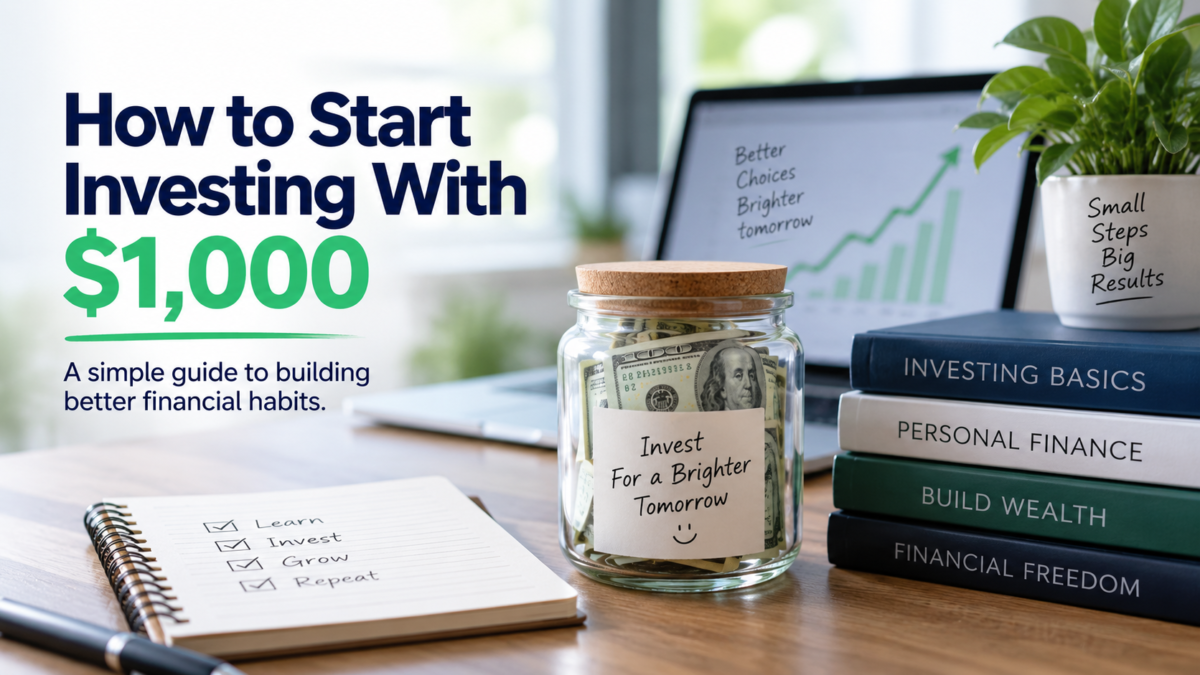
You do not need a huge amount of money to start investing. In fact, $1,000 can be enough to build your first simple portfolio and, more importantly, develop the habit of investing regularly.
The key is not trying to turn $1,000 into a fortune overnight. It is using that money as a starting point.
Start With Your Financial Basics
Before investing, make sure the $1,000 is money you will not need for rent, bills, groceries, or an emergency.
If you have no emergency savings at all, keeping some cash available may be more useful than investing every dollar immediately.
High-interest debt also deserves attention. Paying off expensive credit card debt can sometimes provide a more predictable financial benefit than investing while interest continues to build.
Decide What You Are Investing For
Your investment choices should match your goal.
If you are investing for something that is decades away, such as retirement, you may be comfortable with more market ups and downs.
If you expect to need the money within the next year or two, investing heavily in stocks may not make sense because markets can fall at exactly the wrong time.
Ask yourself one simple question:
When will I realistically need this money?
That answer should guide what you do next.
Consider Keeping It Simple
A beginner does not need ten different investments.
One diversified fund can give you exposure to hundreds or even thousands of companies.
Broad-market index funds and ETFs are popular with long-term investors because they can offer diversification without requiring you to choose individual stocks.
For example, someone starting with $1,000 might choose to invest most of it in a diversified stock-market ETF rather than trying to guess which individual company will perform best.
This does not remove risk. Your investment can still fall in value.
Here is a simple way to compare a few common options for your first $1,000:
| Option | How It Works | Risk Level | Best For |
|---|---|---|---|
| Broad-market ETF | Gives exposure to many companies in one investment | Medium to High | Beginners investing for the long term |
| Individual stocks | You choose specific companies to invest in | High | Investors comfortable researching companies |
| Bonds or bond funds | Invests in government or company debt | Low to Medium | Investors who want lower volatility |
| High-yield savings account | Keeps money in cash while earning interest | Low | Short-term goals and emergency savings |
Do Not Feel Pressured to Invest All $1,000 at Once
You have two basic choices.
You could invest the full amount immediately, or you could spread it out over several months.
For example:
$250 today
$250 next month
$250 the following month
$250 one month later
Spreading purchases out can feel more comfortable for someone investing for the first time.
The more important habit is continuing to invest after the original $1,000 is gone.
Pay Attention to Fees
Fees may look small, but they matter over long periods.
Check for trading fees, fund expense ratios, account charges, currency conversion costs, and other platform fees before choosing an investment account.
A simple, low-cost portfolio is often easier to understand and maintain.
What Could $1,000 Become?
The real power of investing comes from time and continued contributions.
Suppose $1,000 earned an average return of 7% per year.
Without adding any more money, it could grow to roughly $3,870 after 20 years.
Actual investment returns will vary, and a 7% return is only an illustration, not a promise.
The outcome becomes much more meaningful when regular contributions are added.
That is why building the habit matters more than finding the “perfect” first investment.
Final Thought
Starting with $1,000 is less about the amount and more about learning how investing works.
Choose a goal, understand the risks, keep costs under control, stay diversified, and avoid making decisions based on short-term market excitement.
Your first $1,000 will probably not change your financial life by itself.
What you learn from investing it, and what you continue adding afterward, can matter much more.
Important: This article is for general educational purposes and is not personalized financial advice. Investments can rise or fall in value, and you may lose money.

Ritik
Ritik Kungwani is the founder and editor of SmartGrowthInvest, where he writes and oversees content on investing, personal finance, business ideas and practical money tools. His focus is on turning complex financial topics into clear, actionable guidance for readers in the United States, United Kingdom, Canada and Australia. Ritik started SmartGrowthInvest to make financial education more accessible, cutting through jargon and hype to help readers understand the tradeoffs behind investing decisions, side income opportunities, and everyday money management. He oversees the site's editorial standards, including source verification and content review, as outlined in the Editorial Policy. Outside of writing, Ritik focuses on researching market trends, testing financial tools and calculators, and refining how the site presents country-specific financial information. Contact: ritikvanved@gmail.com
View author profile →