
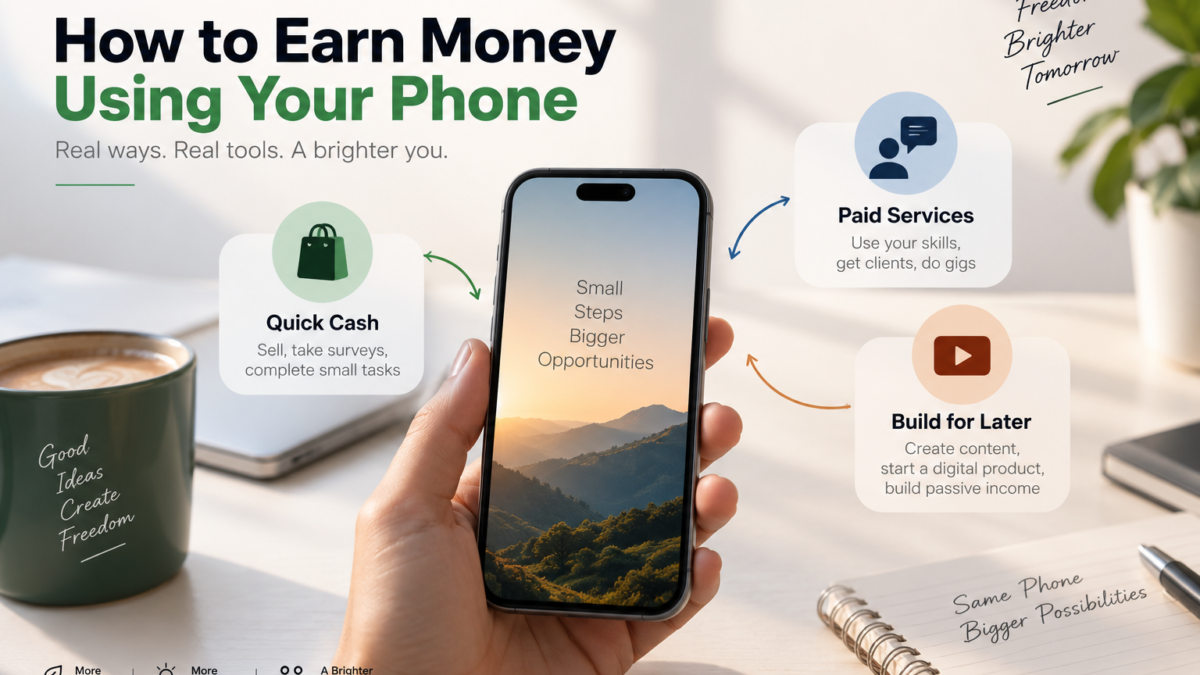
Yes, you can earn money using your phone.
What matters is being clear about what kind of income you want.
If you want a few extra dollars during spare time, surveys, research studies, user testing and microtasks can work. If you want something that could grow into a meaningful side income, selling a service is usually more promising. If you are willing to wait longer, content, affiliate marketing and digital products can eventually scale beyond the hours you personally work.
Those are three very different goals.
A lot of “make money from your phone” advice throws them into one list as if answering a survey and running a social media service are basically the same thing. They are not.
The first may pay you for 10 or 20 minutes of your time. The second can become a recurring client relationship. The third may take months before it earns anything at all.
So before downloading another app, decide which problem you are trying to solve:
- I need some extra cash soon.
- I want flexible work I can do from my phone.
- I want to build something that could become a larger income source.
This guide covers all three.
If you are exploring several ways to increase your income, you can also browse the SmartGrowthInvest Make Money hub for related guides.
The fastest way to choose a phone income method
Here is the short version.
| Method | Can it be done mainly on a phone? | Cost to start | Time to first money | Income ceiling | Best use |
|---|---|---|---|---|---|
| Sell things you own | Yes | $0 | Potentially fast | Limited by what you own | Quick cash |
| Paid research | Often | $0 | Variable | Low to medium | Spare time |
| Microtasks | Yes | $0 | Usually fast once accepted | Low | Filling idle time |
| Surveys | Yes | $0 | Usually fast | Low | Small extra cash |
| User testing | Often | $0 | Variable | Low to medium | Occasional higher-value tasks |
| Short-form video editing | Yes | Low | Moderate | High | Skill-based side income |
| Social media management | Mostly | Low | Moderate | High | Recurring client work |
| Community moderation | Yes | $0 | Moderate | Medium | Remote service work |
| Local lead handling | Yes | $0 | Moderate | Medium to high | Small-business service |
| Reselling | Mostly | Variable | Moderate | Medium to high | People who know products |
| Local gig work | Phone finds the work | Variable | Often fast | Medium | Flexible active income |
| Content and digital products | Mostly | Low | Slow | High | Long-term business building |
“High” does not mean easy. It means the method has more room to grow than completing one-off tasks.
That distinction is important.
A survey app can be easy to join and still be a poor choice if your real goal is an extra $1,000 a month. A service business can take longer to start but may only need a few good clients to become worthwhile.
Can you really make money using only your phone?
For some work, yes.
Modern phones are genuinely good business tools. You can record and edit short videos, take product photos, answer customers, send invoices, post on social media, join calls, list items for sale, accept local jobs and complete some online tasks without touching a laptop.
There are limits.
A phone becomes awkward when the work involves large spreadsheets, heavy research, long-form writing, complex design, coding, large video projects or managing dozens of browser tabs.
That does not mean you cannot start without a computer. It means you should choose work where the phone is an advantage rather than a handicap.
Short-form video is a good example. Vertical video is already designed for a phone screen, so filming, clipping, captioning and publishing from a phone can be perfectly practical.
Trying to build a complicated ecommerce site from the same screen is possible, but “possible” and “pleasant” are different things.
If you need money quickly, start with what you already own
Before signing up for five earning apps, look around your room.
Old electronics, clothes, furniture, tools, collectibles, books, sports equipment and unused appliances may be worth more than a week of low-paying online tasks.
Selling things you already own has three advantages:
- You do not have to qualify for a study or wait for tasks.
- You are not buying inventory.
- Your phone can handle nearly the whole process.
Take clear photos in daylight. Check what similar items are actually selling for, not just what other sellers are asking. Write an accurate description. Mention defects. Reply quickly to serious buyers.
Depending on where you live, you might use eBay, Facebook Marketplace or another local marketplace.
Be careful with payment scams. Do not send verification codes, do not accept suspicious overpayments and do not move a transaction off-platform just because a buyer insists.
Selling your own unused items is not a repeatable income stream forever, but it can be one of the most practical ways to make your first $50 or $100 from a phone.
1. Take part in paid research studies
Paid research is different from the typical “answer 40 questions for points” survey site.
Universities, researchers and companies need people who fit particular demographic or professional profiles. They may want to study buying habits, software use, health behaviors, workplace decisions or opinions about a product.
Two well-known platforms are Prolific and Respondent.
Prolific
Prolific connects participants with research studies. It does not currently have a dedicated mobile app, so you use it through the web. Some studies are designed for phones, while others specifically require a desktop, camera or microphone.
That detail matters. “Works on mobile” does not mean every study can be completed on a phone.
Prolific lets participants filter studies by device type, including phone, so it can still be useful if a smartphone is all you have.
Respondent
Respondent focuses heavily on research interviews, focus groups and professional studies. Opportunities can be more valuable than a normal survey, but you have to match what the researcher needs.
That means you can go days without qualifying for anything.
This is why paid research works best as an occasional income source rather than a budget you depend on.
Who this suits
Paid research makes sense if:
- You have unpredictable pockets of free time.
- You do not want to find your own clients.
- You are comfortable answering screening questions.
- You can accept that opportunities will be irregular.
It is less attractive if you need guaranteed weekly hours.
2. Complete microtasks and AI training work
Microtask platforms break larger projects into small jobs that can be completed by many workers.
The tasks vary.
You might:
- Label images.
- Record short voice clips.
- Take photos.
- Categorize text.
- Check search results.
- Complete a short survey.
- Review information.
- Help create or evaluate data used in AI systems.
Clickworker is one example with an official iOS and Android app. The app shows available jobs, what each job pays and how long the task is reserved for once accepted.
Clickworker itself says pay varies by the project, task difficulty, estimated completion time and skills involved. It also says the platform should not be treated as a substitute for full-time employment.
That is the right way to think about microtasks.
They are useful when you have 20 spare minutes and would otherwise be scrolling. They are not a strong plan for building a dependable salary.
Availability can also change from one day to the next. Your country, profile, qualifications and current client demand may all affect what appears.
How to use microtasks without wasting your time
Track your real hourly return for a week.
If you spend 90 minutes checking for work and completing tasks but only make a small amount, count the waiting and screening time. Do not judge the platform by the highest-paying task you happened to see once.
The point is not to squeeze every possible cent from your phone.
The point is to decide whether your time could be used better somewhere else.
3. Use paid surveys for spare cash, not as a career plan
Surveys are popular because almost anyone can understand the model.
A company wants opinions. A survey platform finds people who match the target audience. You answer questions and receive cash, points or gift cards if you qualify and complete the survey.
The problem is the ceiling.
You may be screened out. Surveys can disappear before you start them. Some demographic groups receive far more invitations than others. Availability differs by country.
So if you use survey apps, set the right expectation.
They can turn idle time into a little money.
They are rarely the best use of an hour if you could instead work on a skill that somebody will pay more for.
A good rule is to use surveys when the alternative really is doing nothing: waiting for an appointment, sitting on public transport or killing time in a queue.
Do not build your financial plan around them.
4. Test websites and apps
User testing pays people to use a website, app or prototype while giving feedback.
You are not being paid because you are a technology expert.
You are being paid because companies want to see where a normal user gets confused.
A test may ask you to:
- Find a particular product.
- Try to complete a checkout.
- Explain what you think a button will do.
- Compare two designs.
- Talk through what is confusing.
- Join a live interview.
UserTesting, for example, says the amount shown for each test varies based on the type of test, its length and customer demand. The platform displays the payment before you choose to take the test.
That is more useful than relying on a blog that claims “user testing pays exactly $X per hour.”
It does not.
Your effective hourly rate depends on how many tests you qualify for, how long screening takes and how frequently suitable work appears.
Who tends to do well
You need to be comfortable speaking clearly.
Instead of clicking silently, you may need to say something like:
“I expected the shipping information to be under Account, but I cannot find it. I am going back to the menu.”
That kind of explanation is the product.
5. Edit short-form videos for creators and businesses
This is where phone-based income starts to become more interesting.
A creator may publish a 40-minute podcast but have no time to turn it into Shorts, Reels or TikToks.
A local business may have plenty of raw footage but no one who knows how to turn it into something watchable.
You can offer that service from a phone.
The work might include:
- Finding a strong 20 to 60 second section.
- Cropping the video vertically.
- Adding readable captions.
- Removing dead space.
- Adding simple on-screen text.
- Writing a caption.
- Exporting the finished clip.
You do not need to begin by buying expensive software.
What matters first is whether you can make a better short video than the client is currently making.
How to get a first client
Do not start by sending 200 generic messages saying:
I am a professional video editor and can help grow your brand.
Creators receive messages like that constantly.
Pick five creators or local businesses you genuinely understand.
Take one piece of their existing public content and make a short sample. Do not publish it as your own. Send it privately and explain what you changed.
For example:
I watched your recent podcast on first-time home buying. The section where you explain the three closing costs would work well as a short. I made a 28-second sample with captions. If this style is useful, I can turn each episode into four clips.
That is a much stronger pitch because the person can see the work.
Once you get a paying client, the goal is not to sell one clip forever. It is to agree on a repeatable package.
Four clips per month.
Eight clips.
Two per week.
Recurring work is what turns a small phone skill into a useful side income.
6. Manage social media for a small business
Many small businesses know they should post online.
Far fewer want to spend their evenings answering comments, filming Stories and figuring out what to post tomorrow.
That creates an opportunity.
You do not have to become a full-service marketing agency.
A beginner can offer a narrow service such as:
- Posting three times per week.
- Replying to comments and DMs.
- Creating simple Stories.
- Turning customer questions into short videos.
- Taking basic photos.
- Scheduling posts.
- Keeping the profile information current.
Think local first.
A salon, restaurant, cleaner, fitness coach, realtor, landscaper or independent store may be easier to understand than a national ecommerce brand.
Find a business with an obvious problem
Look for a business that is already operating successfully but has neglected social media.
Maybe it has hundreds of good Google reviews but has not posted on Instagram for three months.
Maybe its feed shows finished work but never answers common customer questions.
You now have something specific to offer.
Instead of:
I can manage your social media.
try:
You have great before-and-after photos, but most are posted without explaining the job. I could turn those into three weekly posts that answer customer questions and reply to DMs so enquiries do not sit unanswered.
That is a business problem, not a vague marketing promise.
If this starts becoming more than a side hustle, the SmartGrowthInvest Business Ideas hub is a useful next place to explore service-business models.
7. Become a community moderator
Online communities need maintenance.
Spam has to be removed. Questions need answers. New members need directions. Arguments sometimes need to be cooled down before they take over the group.
A creator or business with a growing Facebook group, Discord server, membership community or active comment section may eventually need help.
A phone is well suited to this work because much of it involves reading and responding rather than producing large files.
Typical tasks include:
- Approving posts.
- Removing obvious spam.
- Answering common questions.
- Welcoming new members.
- Flagging customer issues.
- Enforcing community rules.
- Escalating difficult situations to the owner.
How do you find this work?
Being part of the community can help.
If you regularly participate in a group and already understand the tone, rules and common questions, the owner does not have to teach you everything from zero.
You can also approach creators whose communities are clearly becoming too busy for one person.
This is not passive income.
You are being paid for attention, judgment and responsiveness.
But it can be steady work once you build trust.
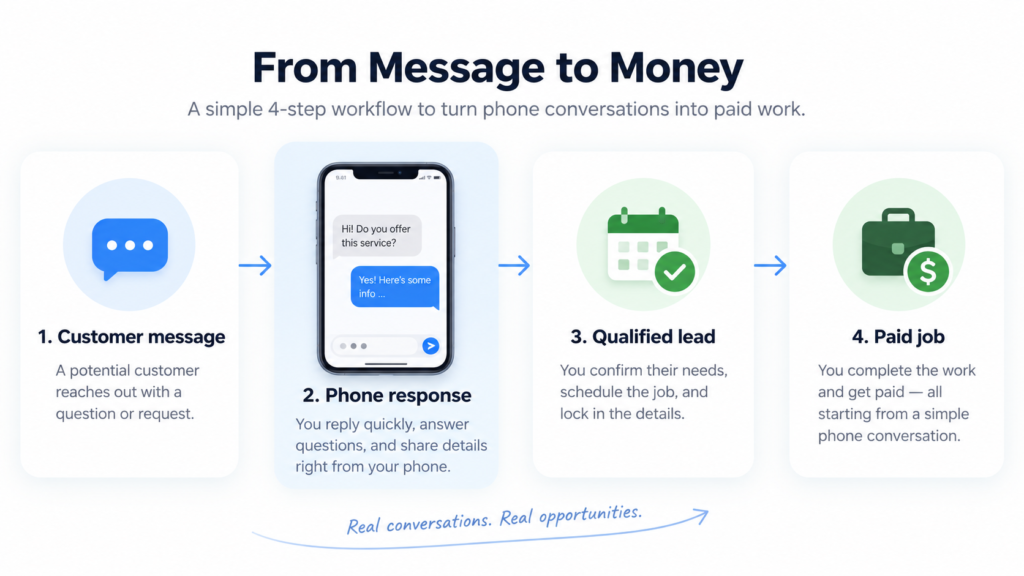
8. Handle leads for a local business
This is one of the more overlooked phone-based services.
Imagine a cleaner is inside a client’s home when this message arrives:
Hi, how much would you charge for a 3-bedroom deep clean this Friday?
The cleaner sees the message four hours later.
By then, the potential customer has contacted three competitors.
That lost lead has value.
The same problem happens to contractors, mobile mechanics, photographers, landscapers, realtors and other small operators who cannot answer every call while they are doing the actual work.
You can offer to handle the first response.
That may include:
- Answering texts.
- Replying to missed calls.
- Asking basic qualifying questions.
- Collecting contact details.
- Checking service areas.
- Booking consultations.
- Passing qualified leads to the owner.
You are not pretending to be the tradesperson.
You are making sure interested customers do not disappear because nobody replied.
Start with one narrow offer
Do not pitch a complicated lead-generation agency if you have never done this before.
Offer something simple:
I can answer new enquiries between 9 a.m. and 5 p.m., collect the job details and book qualified calls into your calendar.
Once you understand the business, you can decide whether to expand into appointment setting, follow-up or marketing.
9. Resell items from your phone
There is a difference between selling your old belongings and deliberately buying things to resell.
The second one is a business.
It can work, but now you have inventory risk.
You might buy:
- Furniture that can be cleaned or repaired.
- Used electronics you understand.
- Collectibles.
- Clothing in a niche you know.
- Tools.
- Clearance items with genuine resale demand.
Your phone can handle the research, photos, listings, messages and payments.
The hard part is not posting the listing.
It is knowing what something is actually worth after platform fees, shipping, repairs, returns and the chance that it does not sell.
Do not confuse asking price with market value
If ten people have listed the same item for $200 and none has sold, that does not prove it is worth $200.
Look for completed or sold listings where the platform provides them.
Start with a category you already understand.
If you know nothing about vintage cameras, do not buy one just because somebody online said camera flipping is profitable.
Knowledge is part of the margin.
10. Use your phone to find local gig work
Some “make money from your phone” methods are really “find work with your phone.”
That is still useful, as long as the distinction is clear.
Apps can connect you with work such as:
- Delivery.
- Cleaning.
- Furniture assembly.
- Moving help.
- Errands.
- Pet care.
- Mystery shopping.
- Local photography.
- Handyman tasks.
The phone provides the marketplace, directions, communication and payment.
You still have to leave the house and perform the job.
Calculate net earnings, not the number in the app
If a gig pays $25, that is not necessarily $25 of profit.
You may have:
- Fuel costs.
- Vehicle wear.
- Parking.
- Equipment.
- Travel time.
- Taxes.
- Platform fees.
- Unpaid time between jobs.
If you are using a car, track mileage and expenses.
A gig that looks attractive before costs can look very different afterward.
11. Build an audience with content
Your phone is already a camera, editing suite and publishing device.
You can make:
- YouTube videos.
- YouTube Shorts.
- Instagram Reels.
- TikTok videos where the platform is available.
- Photography.
- Educational carousels.
- Livestreams.
- Newsletters using mobile publishing tools.
But content creation is not fast cash.
It may take months to build an audience, and some creators never make meaningful money from platform payouts alone.
The reason content is still worth considering is that an audience can support several income streams:
- Advertising.
- Sponsorships.
- Affiliate commissions.
- Freelance services.
- Coaching.
- Memberships.
- Digital products.
- Physical products.
The better question is not:
How much does 1,000 followers pay?
There is no reliable answer.
One creator with 5,000 highly relevant followers might earn more than another with 100,000 people who rarely buy anything.
Audience quality, topic, geography and monetization model all matter.
Start with a problem, not with “being a creator”
Pick something useful you can consistently talk about.
Examples:
- Budget meals.
- Home workouts.
- Car detailing.
- Language learning.
- Local travel.
- Parenting systems.
- Makeup tutorials.
- Career advice in an industry you know.
If the topic solves a real problem, you have more ways to monetize later than if the entire strategy is “post until I become famous.”
12. Use affiliate marketing or sell a digital product
Affiliate marketing is often sold as one of the easiest passive-income methods.
The easy part is getting an affiliate link.
The hard part is getting the right person to click it when they are actually considering a purchase.
A realistic affiliate process looks like this:
- Choose a topic you understand.
- Create useful content around problems in that topic.
- Recommend products when they genuinely fit.
- Disclose the affiliate relationship.
- Earn a commission when a qualifying purchase meets the program’s terms.
Without traffic or an audience, the link has very little value.
Digital products have the same problem.
Making a checklist, template, guide or mini-course is relatively easy.
Finding buyers is the work.
That does not mean you should avoid these models. It means you should build them after you understand the customer.
A simple service can actually be a useful first step. Once ten clients ask the same question, you may have found the subject for a template or guide people would pay for.
Which phone income method should you choose?
Do not choose based on which idea sounds most exciting.
Choose based on your current constraint.
If you need money as soon as possible
Start with:
- Selling things you already own.
- Local gig work that is available in your area.
- Microtasks that you can actually access.
Do not spend three weeks designing a digital product when the problem is that you need $100 for a bill.
If you only have 20 to 30 minutes at a time
Try:
- Paid research.
- Surveys.
- User testing.
- Microtasks.
These methods are easier to stop and start.
If you can dedicate 5 to 10 hours per week
A service is more interesting:
- Short-form video editing.
- Social media management.
- Community moderation.
- Lead handling.
- Reselling.
You have enough time to find customers and improve.
If you want something that could become serious income
Focus on a skill or asset:
- Client services.
- A specialized freelance skill.
- Content with a clear monetization plan.
- Ecommerce.
- Digital products after validating demand.
The phone is no longer the important part.
The valuable part is the skill, customer relationship or audience you are building.
From $5 tasks to a real side income
There is nothing wrong with making your first online money from a survey or a tiny task.
The mistake is staying there for years when you want a much larger income.
A useful progression looks like this.
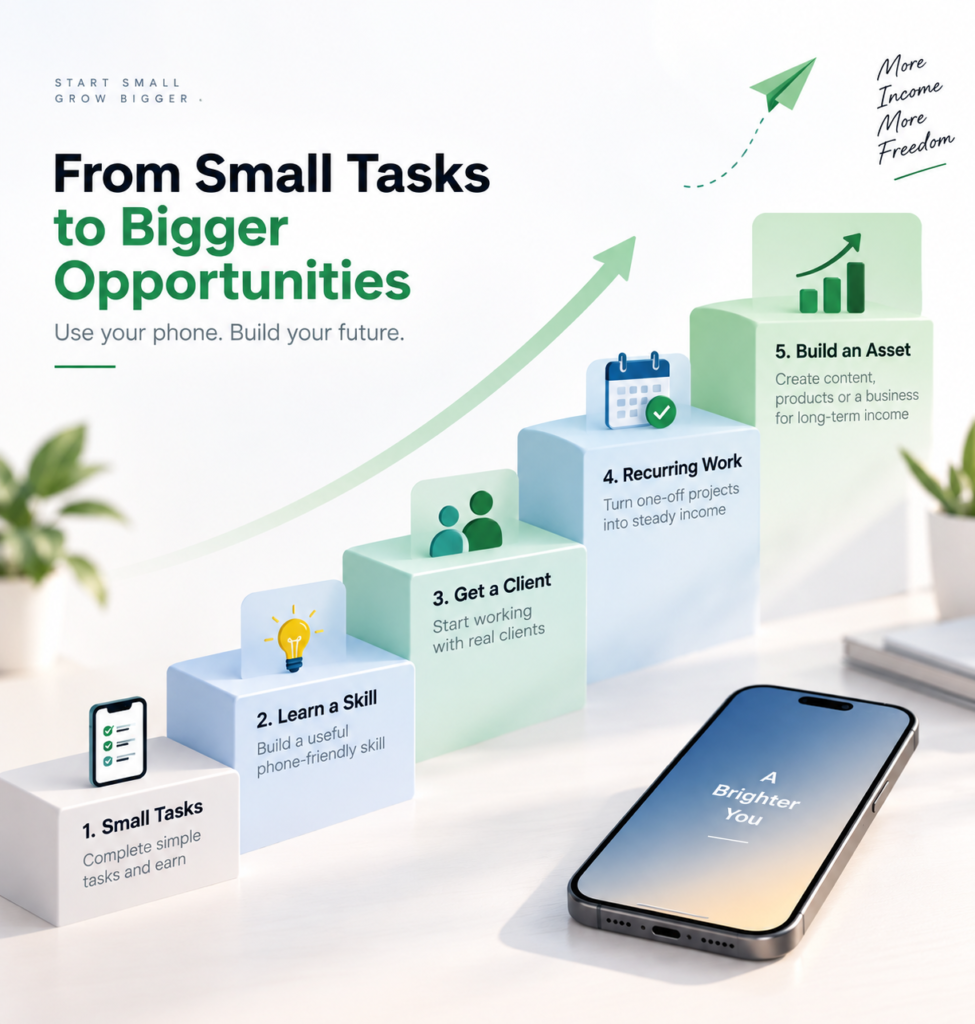
Stage 1: Prove to yourself that online income is real
Complete a legitimate task.
Sell an unused item.
Join a research study.
The amount is not important.
You are learning how online work, payments and platforms function.
Stage 2: Learn one skill people already pay for
Pick something small enough to practice on your phone.
For example:
- Editing vertical video.
- Writing social captions.
- Responding to customer enquiries.
- Designing simple social posts.
- Moderating communities.
Do not learn five things at once.
Stage 3: Sell the skill directly
Find one person with the problem.
Do a paid project.
Then find a second.
At this stage, you learn far more from real customer feedback than another 30 hours of tutorials.
Stage 4: Turn projects into recurring work
Recurring clients reduce the amount of time you spend searching for the next job.
Instead of:
I will edit one Reel for $20.
you eventually want something closer to:
I will produce eight clips each month for a fixed monthly fee.
The exact price depends on your market and skill level.
The model matters more than the number.
Stage 5: Build something that is not tied entirely to your hours
This might be:
- A small agency.
- Templates.
- A course.
- Affiliate content.
- A newsletter.
- A channel.
- A product.
Not everybody needs to reach this stage.
A reliable service income may already solve the problem you started with.
What I would avoid
Some phone income ideas are simply poor uses of time.
Others are dangerous.
Apps promising easy daily income for almost no work
Treat guaranteed earnings with suspicion.
Real platforms usually explain that work depends on availability, eligibility or customer demand.
Paying money to unlock a job
This is a major warning sign.
The U.S. Federal Trade Commission says legitimate side gigs should not require you to pay upfront to get the job.
“Product optimization” or “boosting” tasks sent through WhatsApp or Telegram
The FTC has repeatedly warned about task scams that start with unexpected messages offering simple online work.
The victim is shown fake earnings and may even receive a small initial payment.
Then the platform says the worker needs to deposit money, often cryptocurrency, to unlock more tasks or withdraw the supposed earnings.
Do not send the money.
Jobs that pay you to post fake reviews or ratings
Walk away.
Besides the scam risk, fake reviews are dishonest.
Reshipping jobs
Be very cautious about jobs where your only task is receiving packages, repacking them and sending them somewhere else.
Fake reshipping jobs are a known scam pattern.
Trading, gambling or crypto speculation presented as a side hustle
Buying an asset and hoping its price rises is not the same as earning money from work or a business.
You can make money.
You can also lose it.
I would not put day trading, binary options, sports betting or speculative crypto in the same category as paid research, freelancing or selling a service.
How to check whether a money-making app is legitimate
Before giving a platform your identity documents, bank details or hours of work, do a few checks.
Search the company name plus:
- scam
- complaints
- payment problems
- reviews
Then go to the company’s own help center and find:
- How workers get paid.
- Minimum withdrawal amounts.
- Payment timing.
- Countries accepted.
- Age requirements.
- Whether mobile work is actually supported.
- Whether there are fees.
- What happens if work is rejected.
Be careful with review sites too.
Five-star reviews can be manipulated, and angry reviews do not automatically mean the company is fraudulent.
Look for patterns.
If many people independently describe the same withdrawal problem, pay attention.
A simple 7-day plan if you only have a phone
If you are starting from zero, do not download 15 apps tonight.
Try this instead.
Day 1: Pick your goal
Choose one:
- I need quick cash.
- I want small spare-time earnings.
- I want a side income I can grow.
Day 2: Choose one method
Quick cash: list three things you own.
Spare-time earnings: join one legitimate research or task platform.
Growth: choose one service.
Day 3: Set up properly
Create a dedicated email address if useful.
Finish your profile accurately.
Set up a payment method.
Read the platform rules.
If you are selling a service, create one sample.
Day 4: Do the work, not more research
Complete a task.
Publish a listing.
Send a sample.
Apply for a study.
Contact a potential client.
You need feedback from the real world.
Day 5: Calculate your actual return
How much time did you spend?
How much did you earn?
If nothing paid yet, did you at least create something that can lead to income?
Day 6: Improve one weak point
Better listing photos.
A stronger video sample.
A clearer service offer.
A more complete participant profile.
Do not rebuild everything.
Day 7: Decide whether to continue
Keep methods that show promise.
Drop methods that waste your time.
You do not owe an app another month just because you already spent a week trying it.
Frequently asked questions
Can I really earn money using only my phone?
Yes. Selling items, paid research, surveys, microtasks, user testing, short-form content work, social media management and some freelance services can all be done largely from a smartphone. Some work becomes much easier with a computer as the workload grows.
How can I make money from my phone without paying anything?
Start with methods that do not require inventory or paid software: selling items you already own, paid research, legitimate microtasks, user testing, community moderation or offering a simple service with free mobile tools.
A legitimate job should not require you to pay upfront just to access your earnings.
What is the easiest way to earn money from a smartphone?
Surveys and microtasks are among the easiest to understand, but easy does not mean high-paying. Selling unused items can sometimes produce money faster. Skill-based services take more effort to start but have a much higher ceiling.
How can I make $100 using my phone?
There is no app that can reliably guarantee $100 on demand.
For many people, selling an unused item or completing a paid service is a more realistic route to the first $100 than trying to accumulate it through low-paying surveys.
Which phone jobs can pay the most?
Client work and businesses usually have a higher ceiling than task apps.
Examples include short-form video editing, social media management, lead handling, content businesses and selling products or services.
The tradeoff is that you have to find customers or build an audience.
Can I make a full-time income using my phone?
It is possible to operate some service and creator businesses mainly from a phone, especially at the beginning.
As income and complexity grow, a computer often becomes worth buying because research, administration, editing and file management become easier.
Do not restrict yourself to “phone only” forever if a better tool will save you hours.
Are money-making apps safe?
Some are legitimate. Some are scams.
Use the official website or app store listing, read payment rules, check whether the company operates in your country and never deposit money just to unlock supposed earnings.
Unexpected WhatsApp or Telegram job offers deserve extra caution.
What can I do if I have no skills?
Start with selling unused items, basic tasks or research studies while learning one simple marketable skill.
Video clipping, customer messaging and basic social media management can all be practiced with a phone.
The goal should be to move from “any task I can get” toward work where your skill makes you more valuable.
Can I make money from my phone without social media?
Yes.
Paid research, microtasks, user testing, selling products on marketplaces, local gig apps, freelancing platforms and lead handling can all work without building a public social media account.
What I would do if I were starting with only a phone
I would use two tracks.
First, I would choose one short-term method that could produce some money without months of setup. Selling things I no longer use would be my first choice. After that, I would look at legitimate research, testing or task platforms available in my country.
Second, I would spend part of the week learning one skill that can be sold directly.
That could be short-form video editing, social media support or customer lead handling.
I would not try to turn survey apps into a full-time job.
I would use them for what they are good at: occasional paid tasks.
The bigger opportunity is becoming useful to a person or business.
A phone can absolutely be enough to start.
It does not have to be the only tool you use forever.
And once the extra income becomes consistent, decide what that money is for. If part of it is meant for long-term wealth rather than immediate spending, SmartGrowthInvest’s guide on how to start investing with $1,000 explains the next set of decisions.
Sources & References
- https://consumer.ftc.gov/consumer-alerts/2026/02/how-avoid-side-hustle-scam https://consumer.ftc.gov/consumer-alerts/2025/08/how-spot-avoid-task-scams https://consumer.ftc.gov/consumer-alerts/2026/04/job-offer-text-probably-scam https://participant-help.prolific.com/en/articles/445005-does-prolific-have-a-mobile-app

Ritik
Ritik Kungwani is the founder and editor of SmartGrowthInvest, where he writes and oversees content on investing, personal finance, business ideas and practical money tools. His focus is on turning complex financial topics into clear, actionable guidance for readers in the United States, United Kingdom, Canada and Australia. Ritik started SmartGrowthInvest to make financial education more accessible, cutting through jargon and hype to help readers understand the tradeoffs behind investing decisions, side income opportunities, and everyday money management. He oversees the site's editorial standards, including source verification and content review, as outlined in the Editorial Policy. Outside of writing, Ritik focuses on researching market trends, testing financial tools and calculators, and refining how the site presents country-specific financial information. Contact: ritikvanved@gmail.com
View author profile →